Siwa season by season, from the October date harvest to the summer sand baths, and the history behind Shali, the Oracle of Amun, the tombs and Cleopatra's Spring.
Siwa rewards travellers who know what they are looking at. The crumbling town on the hill, the temple ruins on the edge of the palm groves and the tombs cut into a small mountain all belong to a story that runs from the pharaohs and Alexander the Great to the Siwans who still live here. Here is when to go, season by season, and the history behind the main sights. For getting there, how many days to spend and where to stay, see our Siwa Oasis travel guide; if you want the classic sights in one short trip, our 3-day Siwa Oasis tour from Cairo covers Shali, the Mountain of the Dead, the salt lakes and the Great Sand Sea.
A short history of Siwa
Siwa lies deep in Egypt's Western Desert near the Libyan border, and its isolation shaped everything about it. The State Information Service notes that its people "remained semi-separated from Egypt until the end of the nineteenth century". Siwans are of Berber (Amazigh) ancestry and have kept much of their own language and culture; the local language, Siwi, is a form of Amazigh rather than Arabic.
In Antiquity the oasis was known above all for its oracle. The Egyptians identified the local god with Amun, and Greek visitors, who knew the oasis through the caravan trade, called him Zeus Ammon. The shrine that survives was built under the pharaoh Amasis (who reigned 570 to 526 BC, in the 26th Dynasty), and the oracle's fame spread across the Greek world.
The visitor who made it famous was Alexander the Great, who made the long detour into the desert to consult the god in March 331 BC, in the same months that he was laying out Alexandria. Nobody knows what the oracle told him. What is recorded is that afterwards Alexander worshipped Ammon and was called "son of Zeus" or "son of Ammon", and coins later showed him wearing Ammon's ram's horns. In Roman times the oracle drew far fewer visitors, although the tombs show that Siwa stayed prosperous in the first and second centuries AD. After the arrival of Islam, the old oracle site was turned into a mosque, and in the Middle Ages the Siwans built the fortified town of Shali, which still dominates the centre of the oasis.
Best time to visit Siwa
Siwa has a continental desert climate with sharp swings between the seasons. The State Information Service describes it as "very cold in winter and very hot in summer, and mild in spring and autumn", and advises that "the best time to visit Siwa is in the spring or in the fall". In practice that points to October and November, and March and April.
| Season | What the weather is like | What is happening in Siwa |
|---|---|---|
| Autumn (September to November) | September can still be hot; October and November are more comfortable for sightseeing | Date harvest; the Siyaha festival at Gebel Dakrour, usually in October |
| Winter (December to February) | Cold, especially after dark | A quieter time; the late Takdat dates ripen |
| Spring (March to May) | Mild | Good conditions for walking Shali and the temple sites |
| Summer (June to August) | Very hot | The local sand-bath season at Gebel Dakrour, July to mid-September |
Autumn: dates and the Siyaha festival
Autumn is when Siwa's palm groves are busiest. The oasis has around 280,000 date palms, and its date system has been recognised by the UN Food and Agriculture Organization as a Globally Important Agricultural Heritage System since 2016. Different varieties ripen at different times: one in September, the local Siwi and Azzawi dates at the beginning of October, another at the end of October.
After the harvest comes the Siyaha, also called the reconciliation festival. The State Information Service describes a celebration held every year in October at Gebel Dakrour, a mountain the Siwans consider sacred, lasting three days with almost the whole community taking part. According to a Siwan manuscript, it goes back to 1868, when a local sheikh, al-Tayeb Muslim, called the people to Dakrour to eat together and renew the peace between them. Its dates follow the lunar calendar, so confirm them before planning a trip around it.
Winter: cold nights and quiet days
Winter can be very cold by Egyptian standards. If you travel between December and February, pack proper warm layers, especially for the evenings.
Spring: the second sweet spot
March and April bring the mild weather back and are just as good as autumn for climbing Shali and exploring the temple and tombs.
Summer: heat and the sand baths
Summer is very hot and can make sightseeing uncomfortable. It is also the season of a practice that draws visitors from across Egypt and abroad: the sand baths. From July to mid-September, people come to Gebel Dakrour to be buried in hot sand. Holes are dug each morning and left to heat in the sun, the session takes place in the afternoon, and afterwards the person rests in a tent. It is a traditional local practice handed down over generations; if it interests you, ask locally before you try it.
For the wider picture across the country, see our guide to the best time to visit Egypt, and when your dates are set, plan your Siwa trip with our destination guide.
The sights explained
Shali: the old town of mud and salt
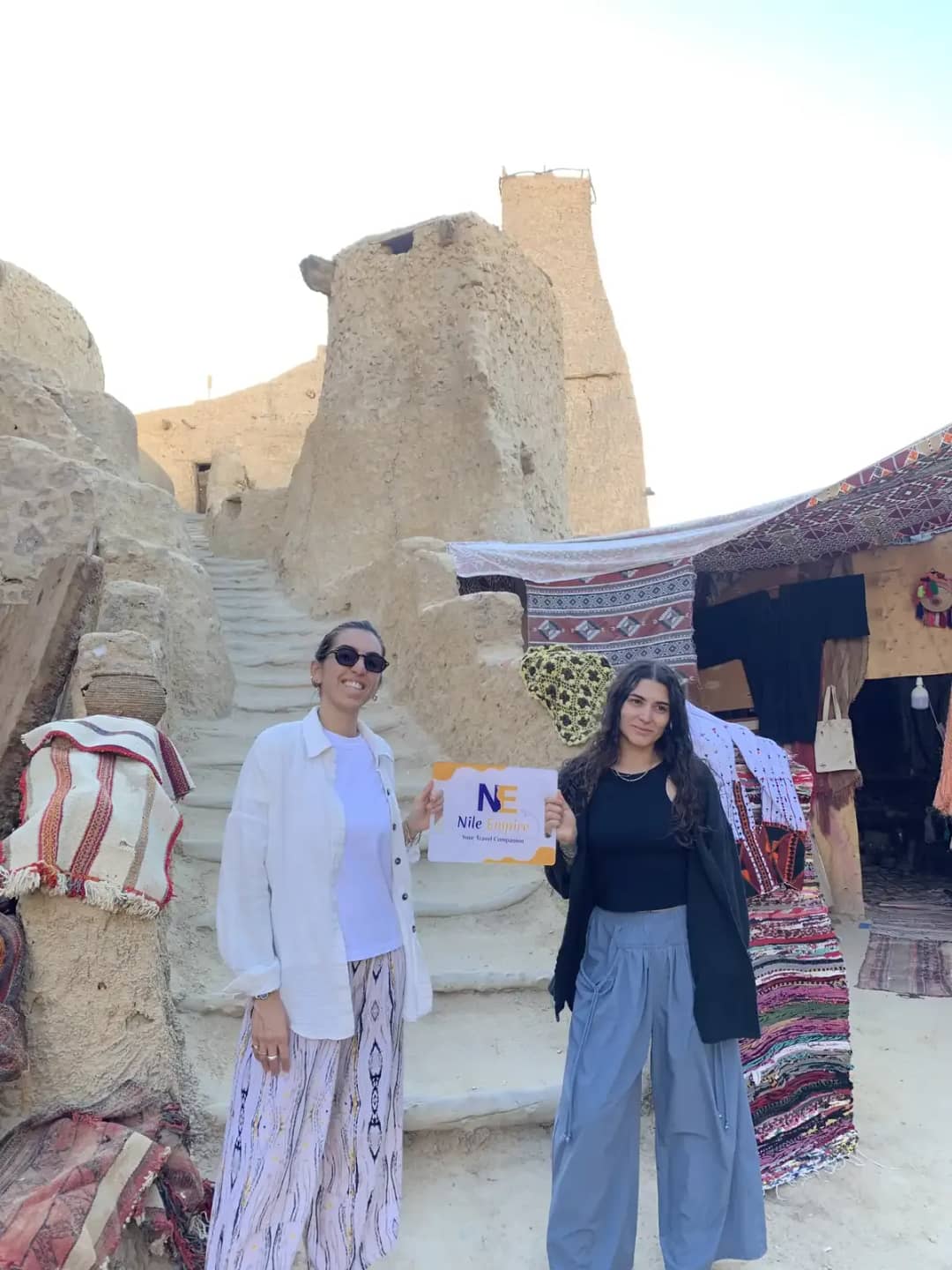
The ruin that rises over central Siwa is Shali, a Siwi word meaning "city". According to the Ministry of Tourism and Antiquities, it dates to the sixth century AH (the 12th century AD), more than 800 years ago. It was built of kershef, clay saturated with salt, which dries almost as hard as cement. A single strong wall with one gate, Bab Anshal, protected the town; later a second gate was opened on the south side near the oil press, and a third for women only.
Kershef has one weakness: water. Siwa sees little rain, but a three-day downpour in 1926 badly damaged Shali. Families later moved to newer houses outside the old walls. Heavy rains in the early 2000s were another reminder of how fragile mud-built houses are. The Ministry has since restored most of the town wall with the original materials and cleared the old lanes, so you can walk up between the houses and mosques, including the old mosque and the Tandi mosque, to views over the palm groves.
The Temple of the Oracle at Aghurmi
The oracle Alexander consulted stands on a partly artificial mound of dried mud about 30 metres high, surrounded by the ruins of the old village of Aghurmi. The temple built under Amasis is small and does not look much like a typical Egyptian temple: a forecourt leads to three rooms in succession, built in an almost Greek manner. In the innermost room, a damaged frieze shows Amasis making offerings to Amun and other gods; opposite, the figure of Siwa's own ruler has faded, but his remarkable title is still legible: "king of Upper and Lower Egypt and chief of the lands in the desert".
About 400 metres to the south, a second temple was built by the pharaoh Nectanebo II. Only a wall fragment and some roof blocks survive, but they show that it faced the oracle.
The Mountain of the Dead (Gebel al-Mawta)
On the northern edge of the town, this small hill is honeycombed with rock-cut tombs. Most date from the 26th Dynasty, the Ptolemaic period and Roman times, and burials continued here until the late Roman era. The site is known for four tombs in particular; one of them, the tomb of Si-Amun, has painted walls that show a man thought to be a Greek landowner or merchant praying to Egyptian gods, a clear blend of Egyptian and Greek styles. During the Second World War, Siwans sheltered in the tombs from air raids. After the royal tombs of the Valley of the Kings, these smaller private tombs show a more local side of Egyptian burial.
Cleopatra's Spring
Siwa sits in a depression where the water table is high, which is why it has so many springs and wells. Among them is the round stone pool known as Cleopatra's Spring or Cleopatra's Bath. The name is a popular label: in Antiquity this was known as the Spring of the Sun. The Greek historian Herodotus wrote in the fifth century BC that its water was warm at dawn, cold at midday and boiling at midnight, a description modern commentators consider exaggerated.
The salt lakes
The same high water table explains the lakes. The springs produce more water than the desert air can evaporate, so large lakes have formed east and west of the town; the oasis is ringed by salt lakes fed by its springs. Salt runs through daily life here: it went into the kershef of Shali, and local craftsmen still carve salt rock into lamps and other objects. The bright blue pools where visitors float today belong to this same salt landscape; our destination guide covers where to swim and what to bring.
The Great Sand Sea
South of the oasis begin the dunes of the Great Sand Sea, a vast field of sand that stretches towards the Libyan border. Together with the long distance from the Nile, this desert is what kept Siwa so isolated for so much of its history.
Frequently Asked Questions
What is the best month to visit Siwa Oasis?
October is a strong choice. Egypt's State Information Service names spring and autumn as the best seasons for Siwa, and October adds the date harvest and, usually, the three-day Siyaha festival at Gebel Dakrour. November, March and April are also mild; winter nights are cold and summer is very hot.
Did Cleopatra really bathe at Cleopatra's Spring?
Treat it as a legend. The Cleopatra name is a later popular label. Herodotus described the spring in the fifth century BC, but there is no reliable evidence that Cleopatra bathed there.
Can you visit the Oracle temple that Alexander the Great consulted?
Yes. The ruins of the Temple of the Oracle stand on the Aghurmi hill, among the remains of the old village, and are one of the highlights among the oasis's historic sites. Alexander visited in March 331 BC; what the oracle told him was never recorded.
When are the sand baths used in Siwa?
In summer. The sand-bath season at Gebel Dakrour runs from July to mid-September, when people are buried in sun-heated sand in the afternoon and then rest in a tent. It is a traditional local practice; ask locally if you are interested.
What is kershef, the material Shali is built from?
Kershef is clay saturated with salt, with chunks of salt from the local lakes, and it dries almost as hard as cement. It lasts well in a dry climate but dissolves in heavy rain, which is why three days of rain in 1926 badly damaged Shali.