A visitor's guide to the Egyptian gods: the heads, crowns and symbols that identify them, the myths behind the scenes, and the temples where you can see them today.
Walk into a temple in Luxor or Aswan and the walls are crowded with figures: falcon heads, ram horns, tall feathered crowns, women with cow horns around a sun disk. Learn a few clues and most of them stop being anonymous. This guide shows how the Egyptian gods are recognised, introduces the ones you are most likely to meet, and points you to the temples where you can still see them.
How to recognise a god on a temple wall
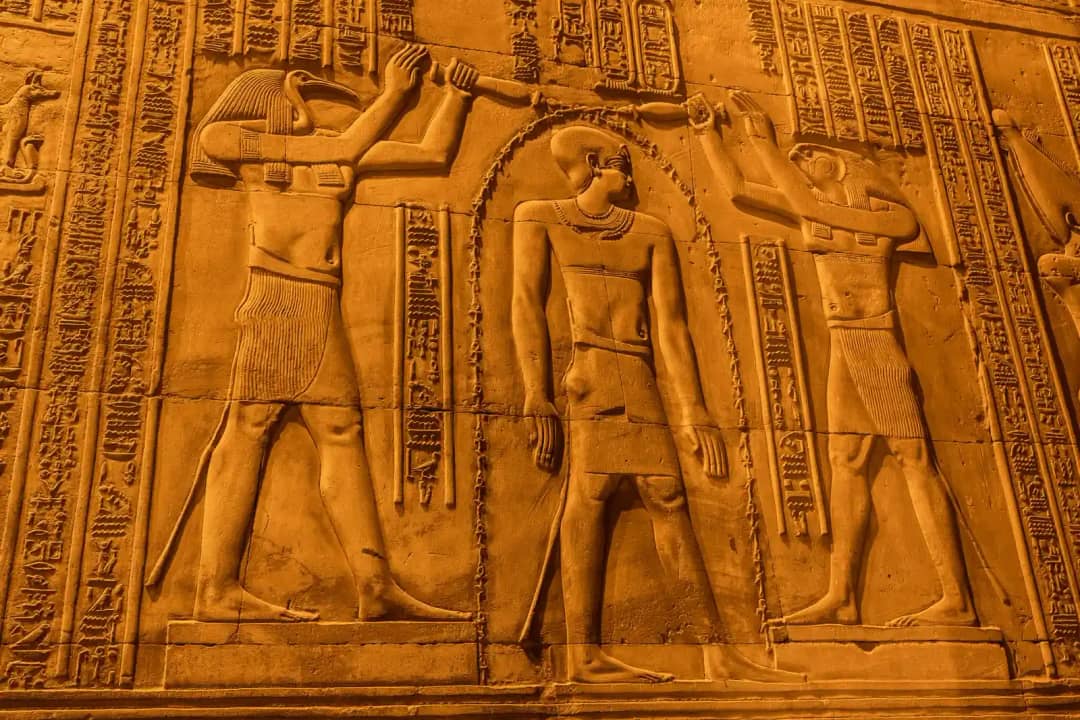
Egyptian artists gave gods human bodies, animal heads or full animal forms, and the animal referred to the god's character rather than a literal appearance: Sobek's crocodile head, for example, alludes to his fierceness. Four clues do most of the work:
- The head. Falcon, ibis, jackal, ram, crocodile, lioness and cat heads each belong to a small group of gods.
- The crown. Two tall feathers, a sun disk, cow horns around a disk, a throne or a single ostrich feather narrow the choice.
- What the figure holds. The ankh is the sign for life; the crook and flail are symbols of royal authority carried by Osiris; the sistrum is a sacred rattle linked with Hathor and Bastet.
- The name. When two gods share a look, the hieroglyphs settle it. A statuette of Ra-Horakhty in the Art Institute of Chicago is identified by the words on its belt: "Re-Horakhty, Chief of the Gods".
Watch for look-alikes. A falcon-headed man with a sun disk points to Ra-Horakhty, while Horus commonly wears the double crown. A jackal can be Anubis or Wepwawet, another guardian of burial grounds. Isis sometimes wears the sun disk between cow horns known as the Hathoric crown. If in doubt, ask your guide to read the name; our guide to Egyptian hieroglyphics explains how the signs work.
The Egyptian gods you are most likely to meet
Amun and Amun-Ra
Amun, the god of Thebes (modern Luxor), is a man wearing a crown of two tall feathers; he can also appear as a ram or a goose. He rose with his city, and his Great Temple at Karnak became extremely wealthy. Joined with the sun god he became Amun-Ra, and at Luxor Temple he had a local form, Amenemopet. Luxor Temple and Hatshepsut's temple both carry scenes presenting Amun as the ruler's true father.
Mut
Mut is Amun's wife and the mother of the Theban family, with her own precinct at Karnak, south of Amun's (it has a separate ticket). She is associated with the vulture headdress, but Isis sometimes borrows it and queens wore it too, so check the name. On a royal stela at Gebel el-Silsila, Mut leads the king towards Amun-Ra, Ra-Horakhty and Ptah.
Khonsu
Khonsu, son of Amun and Mut, is a moon god: a child with a side braid, or a robed figure holding a sceptre and crowned with a full moon resting on a crescent. He was valued as a healer able to drive out evil spirits. His temple, begun under Ramesses III, stands in the south-western corner of the Amun precinct at Karnak. At Kom Ombo, a different family claims him as the son of Sobek and Hathor.
Ra and Ra-Horakhty
Ra, the sun god, was often combined with other gods. With Amun he became Amun-Ra; with Horus of the Horizon he became Ra-Horakhty, a falcon-headed man crowned with a sun disk, revered especially at Iunu, the city near modern Cairo that the Greeks called Heliopolis. Hatshepsut's temple has an open-air altar to Ra-Horakhty, and he sits among the four figures in the sanctuary at Abu Simbel.
Ptah
Ptah was the god of Memphis, the ancient capital near Cairo. His temple there was so important that the word "Egypt" comes, through Greek, from its ancient name, Hikuptah. He was credited with creating humankind through the power of thought and was the patron of craftspeople. In the south you meet him in the Abu Simbel sanctuary and in one of the seven chapels of Seti I's temple at Abydos.
Sekhmet
Sekhmet, "the powerful one", is a lioness-headed woman crowned with a sun disk and a cobra. Ptah's consort, she could make enemies fall sick or heal the afflicted. Amenhotep III dedicated hundreds of large granodiorite statues of her at Thebes, and many were later moved to the temple of Mut at Karnak; some are now in museums abroad.
Bastet
Bastet was first shown as a lioness and later as a cat, her sacred animal, which is why she is easily confused with Sekhmet. She was a goddess of fertility and protection, and the two were sometimes seen as the wild and the tame side of one unpredictable goddess. One of her main cult temples was at Tell Basta (ancient Bubastis), where an open-air museum shows a black granite head of Bastet as a lioness.
Osiris
Osiris is a mummified king holding a crook and flail, recalling his role as Egypt's first king; after his murder he became ruler of the underworld. Abydos was a pilgrimage centre for his worship, and Seti I's temple there has an Osiris chapel leading into halls devoted to his cult. Dead kings were identified with Osiris, which is why Hatshepsut's temple has statues of her in mummy form as Osiris.
Isis
Isis typically wears a throne on her head, echoing her name, but she can also wear the vulture headdress or the horned sun disk, and sometimes spreads wings as a protector of the dead. Her great temple is at Philae, one of the last Egyptian temples in use: a priest of Isis carved the last dated hieroglyphic inscription there in AD 394.
Horus
Horus is a falcon or a falcon-headed man, commonly in the double crown, and each king was considered the living Horus on earth. At Edfu, his great temple, two granite falcons stand before the pylons. His forms should not be merged: at Kom Ombo he is Harwer (Horus the Elder), the adult god who defeated Seth; Horus the Child is a boy with a side lock and a finger to his mouth; joined with Ra he becomes Ra-Horakhty. The wedjat, or Eye of Horus, was worn as a charm for wholeness and health.
Seth
Seth, brother and murderer of Osiris, was a god of the desert, thunderstorms and foreign lands. He is usually shown as the "Seth animal", a dog-like creature with a forked tail.
Hathor
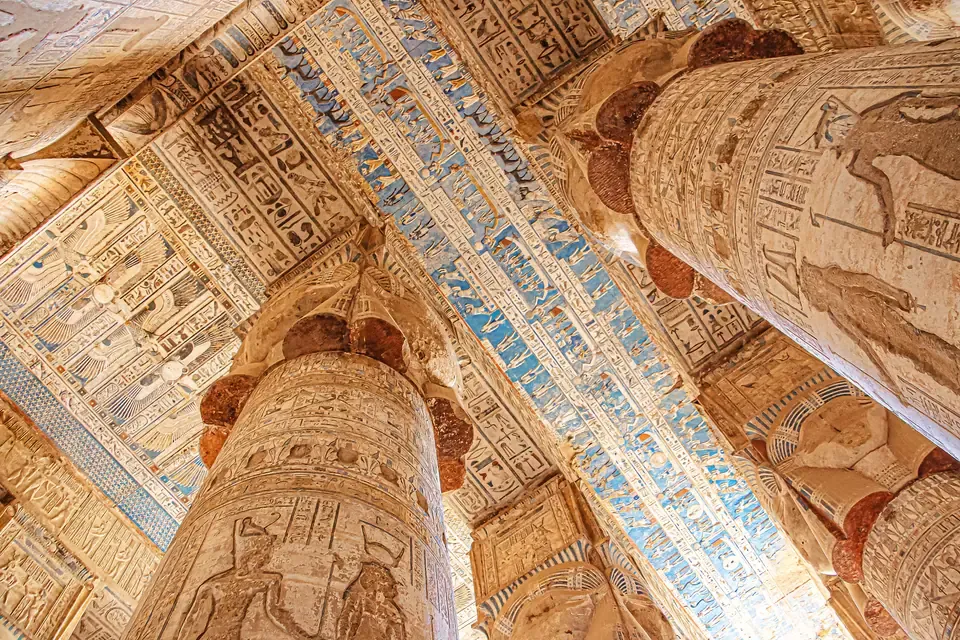
Hathor, goddess of music, joy, dance and motherhood and a lady of the sky, appears as a cow, with the sun disk between cow horns, or as a woman's face with cow's ears on columns and sistra. At Dendera, her main cult centre, six massive columns topped with her head front the temple. Stelae at Deir el-Bahari show her as a cow emerging from the hills. Look for her also in Hatshepsut's temple, on Philae, in the Small Temple at Abu Simbel (dedicated to her and Queen Nefertari) and at Kom Ombo as Sobek's wife.
Sobek
Sobek is a crocodile or a crocodile-headed man, sometimes crowned with horns, feathers and a cobra, a god of fertility linked with water, the Nile flood and vegetation. At Kom Ombo he shares a double temple with Horus the Elder: the southern axis and sanctuary (on the right) are his, the northern ones belong to Horus.
Anubis
Anubis is a jackal, or a man with a black jackal's head: the god of embalming and mummification and a guardian of burial grounds. Hatshepsut's temple includes a section for his cult, and the Mummification Museum in Luxor explains the process he presided over.
Thoth
Thoth is an ibis-headed man, or a baboon, sometimes with a moon disk. He was the god of the moon, writing and wisdom, and the scribe who records the verdict when the dead are judged.
Maat
Maat is a woman with an ostrich feather on her head, sometimes winged. She stands for truth, justice and order, which temple rituals were meant to uphold. Look for the king offering a small figure of Maat to the gods, as on a stela of Ramesses III at Gebel el-Silsila.
Khnum
Khnum is a ram-headed man, a creator god shown shaping people on a potter's wheel before they were born. His main cult centre was Elephantine Island at Aswan, where scenes group him with the goddesses Satet and Anqet as the Aswan triad, and he was the local god of Esna, where restored scenes show priests carrying his sacred boat.
Divine families, and why they differ
Families depended on the place. At Thebes the family was Amun, Mut and Khonsu, whose cult images were carried from Karnak to Luxor Temple in the Opet Festival. At Memphis, Ptah's consort was Sekhmet. At Kom Ombo, Sobek is paired with Hathor and their son Khonsu. The creation story of Heliopolis gave the best-known family tree: Shu and Tefnut, their daughter Nut (the sky) and her husband Geb (the earth), and Nut's children, including Osiris, Isis, Seth and Nephthys. Nut is drawn as a woman arching over the earth who swallows the sun each evening and gives birth to it each morning.
The Osiris myth
Seth, jealous of his brother Osiris, killed him and scattered the pieces of his body across Egypt. Isis, helped by her sister Nephthys, gathered the pieces, bound them with linen and revived Osiris long enough to conceive Horus, and Osiris became lord of the underworld. Isis hid the child until he could challenge Seth; Horus won the throne, although Seth damaged his eye and Thoth restored it. Temples show related versions of these myths: Philae's birth house depicts Isis nursing Horus, Kom Ombo shows Horus the Elder defeating Seth, and Abydos has chapels for Osiris, Isis and Horus side by side.
The judgement of the dead
This scene comes from the Book of the Dead, papyrus rolls of spells, often illustrated, placed with the dead. In spell 125 the heart of the deceased, thought to hold memory and character, is weighed against the feather of Maat. Anubis tends the scales and Thoth records the result. A heart heavier than the feather is devoured by the monster Ammit; one that balances lets its owner continue into the afterlife, the realm of Osiris.
Where to see the gods in Egypt
| Temple | Gods | What to look for |
|---|---|---|
| Karnak | Amun, Mut, Khonsu | Great Temple of Amun, Precinct of Mut, temple of Khonsu |
| Luxor Temple | Amun, Mut, Khonsu | Opet Festival scenes on the Great Colonnade; Divine Birth scenes |
| Hatshepsut's temple | Amun, Hathor, Anubis, Ra-Horakhty | Amun's rock-cut sanctuary, Hathor and Anubis sections, open-air altar |
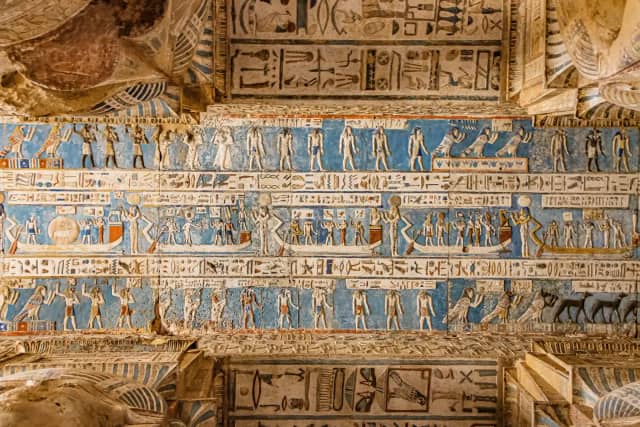
| Dendera | Hathor | Hathor-headed columns; astronomical ceiling |
| Abydos (Seti I) | Osiris, Isis, Horus, Amun-Ra, Ra-Horakhty, Ptah | Seven chapels, including one for the deified Seti I |
| Esna | Khnum | Priests carrying Khnum's sacred boat |
| Edfu | Horus, Hathor | Granite falcons; Horus and Hathor in the sacred bark |
| Kom Ombo | Sobek, Horus the Elder | Twin axes and sanctuaries |
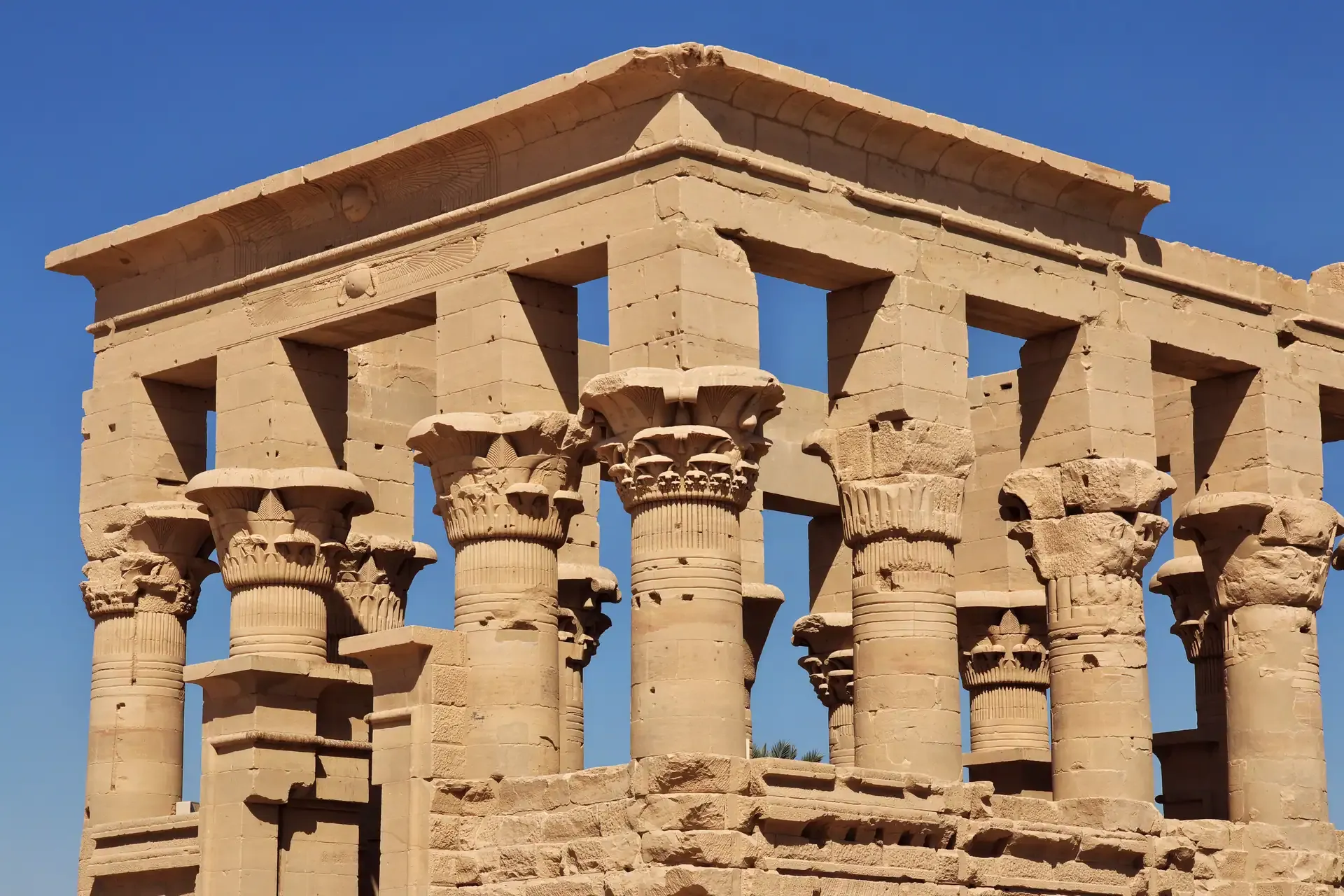
| Philae | Isis, Osiris, Horus, Hathor | Birth house; offerings on the Kiosk of Trajan |
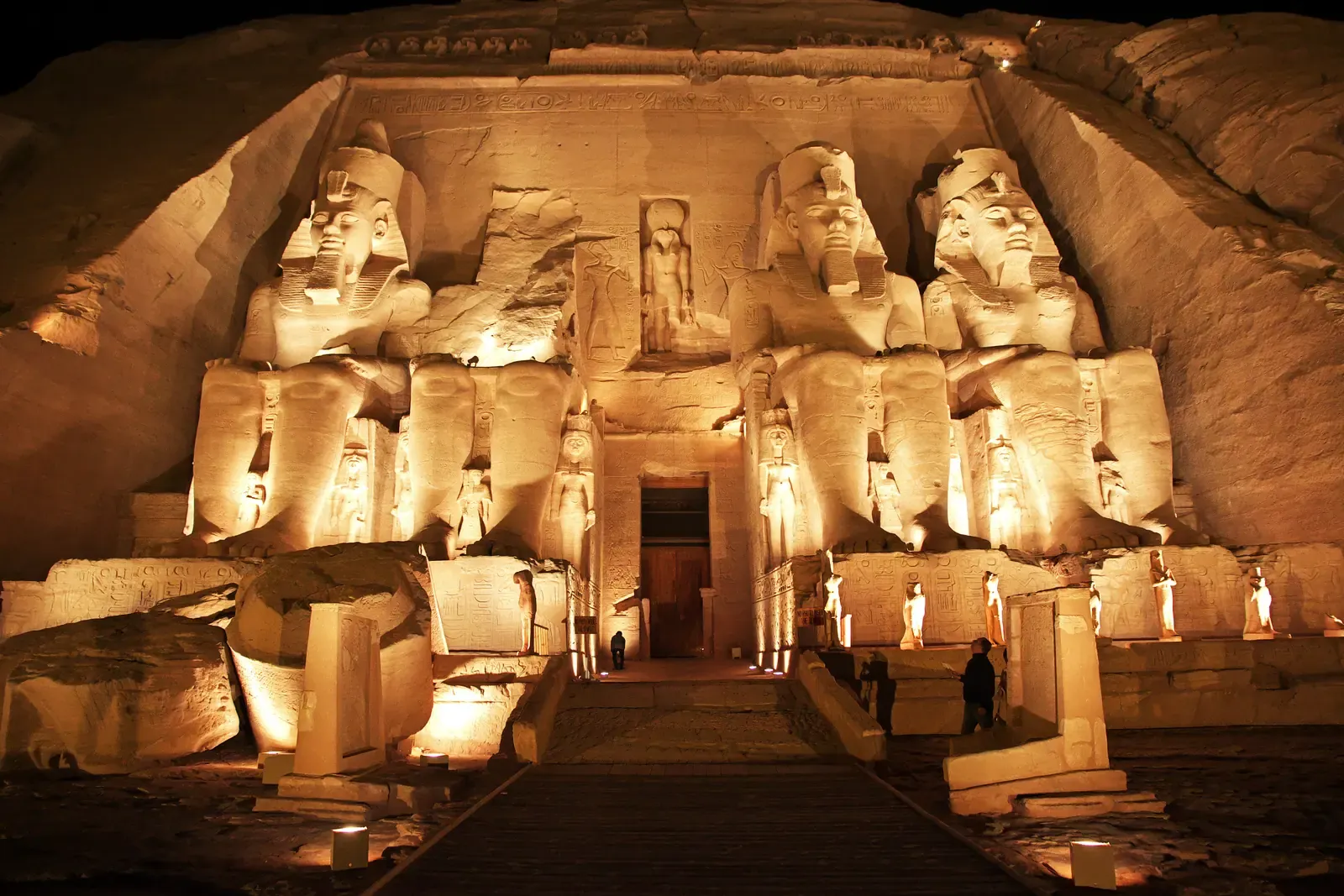
| Abu Simbel | Amun-Ra, Ra-Horakhty, Ptah, Hathor | Four seated figures in the sanctuary; Small Temple |
Karnak and Luxor Temple make up the Luxor East Bank tour, and our guide to Luxor attractions covers the rest of the city. Dendera and Abydos make a full day north of Luxor on the Dendera and Abydos temples tour. Philae is covered in our Aswan guide, and at Abu Simbel the sun reaches the sanctuary statues on 22 February and 22 October, as our Abu Simbel Sun Festival guide explains.
For the history behind these temples, read our guide to ancient Egyptian history. If you would like a certified Egyptologist to decode the walls with you, we can build these temples into a tailor-made trip.
Frequently Asked Questions
Who was the most important god in ancient Egypt?
It depended on the period and the place. Ptah was the great god of Memphis, the early capital. At Thebes, Amun rose with the city, merged with the sun god as Amun-Ra and came to be seen as king of the gods, and his temple at Karnak became enormously wealthy. Ra, the sun god, was also called king of the gods, and many gods were combined with him.
Why do Egyptian gods have animal heads?
The animal refers to the god's character, not to how the god was thought to look. Sobek's crocodile head, for example, alludes to his fierceness. The same god could be shown as an animal, as a human, or as a mix of the two, and each form was a way of expressing what the god stood for.
Are Horus and Ra the same god?
No. Horus is the god of kingship, the son of Osiris and Isis, commonly shown as a falcon-headed man wearing the double crown. Ra is the sun god. Ra-Horakhty is a combined form of Ra and Horus of the Horizon, shown as a falcon-headed man crowned with a sun disk, which is why the two are easily confused on temple walls.
What is the weighing of the heart?
It is the judgement scene of the Book of the Dead. The heart of the dead person is weighed against the feather of Maat, the goddess of truth and order. Anubis tends the scales and Thoth records the result. A heart heavier than the feather is eaten by the monster Ammit; a heart that balances lets its owner continue into the afterlife.
Where can I see Isis in Egypt?
The main place is Philae near Aswan, where the temple of Isis includes a birth house scene of Isis nursing her son Horus, and the Kiosk of Trajan shows the emperor making offerings to Isis, Osiris and Horus. The temple of Seti I at Abydos also has a chapel for Isis beside those of Osiris and Horus.