
Egypt is a mesmerizing, sensory-rich destination that captivates the soul. From the awe-inspiring monuments of the ancient pharaohs to the bustling, spice-scented alleyways of its historic bazaars, it is a country that promises the adventure of a lifetime. However, as you begin researching your trip and reading reviews from fellow travelers looking into Egypt tour packages, a common theme inevitably emerges. Alongside the glowing praise for the Pyramids and the Nile, you will frequently encounter stories of overwhelmed tourists trying to figure out exactly how to deal with street vendors in Egypt.
Let us address the elephant in the room with absolute candor: the street vendors, souvenir hawkers, and camel drivers at Egypt’s major tourist sites are famous for their relentless persistence. For a first-time visitor—especially one accustomed to the polite, hands-off retail culture of the West or parts of Asia—stepping out of a tour bus at the Giza Plateau can feel like walking into a high-pressure sales gauntlet. You will be offered everything from papyrus bookmarks and plastic scarabs to camel rides and impromptu guided walks. They will follow you, initiate conversation in multiple languages, and use every psychological trick in the book to close a sale.
But here is the most important thing you need to know before you board your flight: this aggressive salesmanship should never deter you from experiencing the wonders of Egypt. It is simply a cultural nuance, a high-energy form of making a living in a country heavily reliant on tourism. With the right mindset, a few practical behavioral strategies, and—most importantly—the strategic advantage of traveling with a local expert guide, navigating the souvenir gauntlet becomes incredibly easy. In fact, it can even become an entertaining part of your cultural immersion.
In this comprehensive guide, we are going to dive deep into the psychology of the Egyptian hustle. We will provide you with actionable, step-by-step tactics to politely but firmly decline unwanted offers, outline the exact rules of engagement for bargaining when you actually want to buy, and reveal the ultimate travel hack for completely neutralizing vendor harassment. Let’s master the art of navigating Egypt’s vibrant streets.

Quick Snapshot: The Do’s and Don’ts of Vendor Interactions
Before we get into the advanced psychology and location-specific strategies, it is essential to establish a baseline of behavior. The following table provides a quick, easy-to-digest summary of the fundamental “Do’s and Don’ts” when figuring out how to deal with street vendors in Egypt. Keep these principles in mind the moment you step out of your hotel.
| Action / Scenario | What You Should DO (Best Practice) | What You Should NEVER DO (Common Mistake) |
|---|---|---|
| Initial Approach | Say “La Shukran” (No thank you) firmly and keep walking. | Stop walking, look at merchandise, or say “Maybe later.” |
| Eye Contact | Look straight ahead or wear dark sunglasses. | Make extended eye contact or smile apologetically. |
| “Free” Gifts | Keep hands in pockets. Let objects fall to the ground. | Accept a “gift for good luck.” Payment will be demanded. |
| Answering Questions | Ignore generic questions like “Where are you from?” | Engage in polite small talk if not buying. |
| Physical Contact | Maintain personal space. Step back confidently. | Allow a vendor to place a headdress on you. |
Understanding the Psychology of the Egyptian Hustle
To master how to deal with street vendors in Egypt, you must first understand the environment and the mindset driving their behavior. It is vital to realize that their persistence is rarely malicious; it is purely economical. Egypt is a developing nation where the average income is relatively low, and the tourism sector provides a critical lifeline for millions of families.
It Is Just Business, Not Personal
In Western cultures, if someone says “No” once, asking again is considered incredibly rude. In Egyptian street commerce, “No” is merely viewed as the opening negotiation of a transaction. The vendor’s job is to wear down your resistance. They are masters of reading body language. If you look hesitant, overly polite, or apologetic when declining, they sense an opening. They know that many tourists feel guilty saying a harsh “no,” and they use that cultural guilt to their advantage. Recognizing that this is a theatrical performance rather than a personal attack allows you to detach emotionally from the situation.
The “Foot in the Door” Technique
Vendors at sites like the Pyramids or the Valley of the Kings will rarely start by asking you to buy something expensive. Instead, they use classic “foot in the door” sales techniques. A common tactic is to ask a seemingly innocent question: “Where are you from, my friend?” The moment you answer “Canada” or “The UK,” you have established a rapport. The vendor will then miraculously reveal they have a cousin in Toronto or London, building a false sense of familiarity. Another tactic is the “free gift” maneuver. They will thrust a small carved scarab into your hand and say, “For you, for good luck, welcome to Egypt!” The moment your fingers close around the object, the psychological trap is sprung. When you try to walk away, the tone shifts, and they demand money for their “gift.”
Practical, Field-Tested Strategies to Repel Unwanted Sales
Now that you understand the game, how do you win it? Navigating these interactions requires a shift in your usual polite demeanor. You must adopt a confident, slightly assertive persona.
1. Master the Magic Phrase: “La Shukran”
If you learn only one phrase in Arabic before your trip, make it “La Shukran” (pronounced Lah Shook-ran), which translates directly to “No, thank you.” Saying this while making a dismissive hand gesture (putting your hand over your heart or holding it up like a stop sign) is incredibly effective. It signals to the vendor that you are not a clueless first-day tourist, but someone who understands the local norms. Say it once, say it firmly, and do not repeat it.
2. The Power of Dark Sunglasses and Forward Momentum
Eye contact is the universal currency of street vendors. If you look at them, you are inviting engagement. If you look at their wares, you are expressing interest. Wear dark sunglasses while exploring outdoor monuments. This completely conceals your line of sight, making it impossible for a vendor to tell if you are looking at their papyrus or the 4,000-year-old temple behind it. Combine this with forward momentum. Walk with purpose. If a vendor steps into your path, do not stop; simply alter your trajectory and keep moving toward your destination. A moving target is significantly harder to sell to than a stationary one.
3. Do Not Take Offense, Keep Your Sense of Humor
Sometimes, the best way to deal with an incredibly persistent vendor is with a smile and a joke. Some of the lines they use are genuinely hilarious (“How can I help you spend your money today?” or “Looking is free, buying is cheaper!”). You can laugh, say “Not today, my friend,” and keep walking. Getting visibly angry, yelling, or losing your temper is counterproductive and goes against the cultural norm of hospitality. Firmness wrapped in a polite smile is the ultimate shield.

The Ultimate Hack: Traveling With a Local Tour Guide
While the strategies mentioned above are highly effective for solo backpackers, the absolute best, most foolproof method for figuring out how to deal with street vendors in Egypt is simply this: don’t deal with them at all. Let your guide do it.
If you book your excursions through a reputable, premium agency like Nile Empire, the dynamic at tourist sites completely changes. When you travel with a licensed, local Egyptologist guide, you are instantly enveloped in an invisible bubble of protection. Street vendors operate on a strict, unspoken hierarchy of respect. They know that licensed guides are local professionals conducting business, and they will generally not harass the guests of a recognized guide.
Our expert guides serve as an impenetrable buffer. If a vendor approaches our clients, the guide will handle the situation with a quick, firm word in Arabic, instantly dismissing the seller without you having to lift a finger or break your concentration on the incredible history surrounding you. Furthermore, if you do want to buy a souvenir, your guide becomes your greatest asset. They will tell you exactly what a fair price is, steer you away from cheap plastic knock-offs, and negotiate on your behalf in fluent Arabic to ensure you get the “local price” rather than the inflated “tourist price.”
🛡️ Enjoy a Hassle-Free Experience at the Pyramids
Don’t let aggressive vendors ruin your once-in-a-lifetime view of the Sphinx. Book our private Half-Day Tour to Giza Pyramids & the Sphinx with Camel Ride. Our expert guides will handle all the logistics, ward off the hawkers, and arrange your camel ride at a pre-negotiated, fair price so you can focus entirely on the magic of ancient Cairo.
Comparison: Navigating Egypt Solo vs. With a Guided Tour
To truly illustrate the immense value of having a local expert by your side when navigating Egypt’s complex street commerce, let us compare the typical experience of a solo traveler versus a traveler on a comprehensively guided tour.
| Experience Factor | Solo / Unescorted Traveler | Nile Empire Guided Tour |
|---|---|---|
| Harassment Level | Very High. Primary target for hawkers. | Extremely Low. Vendors respect the guide. |
| Bargaining | Stressful. High risk of overpaying. | Effortless. Guide negotiates fair local prices. |
| Navigating Sites | Confusing. Must fend off fake helpers. | Seamless. Direct access to highlights. |
| Mental Energy | Drained. Saying “no” detracts from enjoyment. | Relaxed. 100% focus on history and sights. |
How to Bargain Like a Pro When You Actually Want to Buy
Eventually, during your trip, you are going to see something you genuinely want. Whether it is an intricate alabaster vase in Luxor, a custom-painted papyrus scroll, or a vibrant bag of saffron in the Khan el-Khalili bazaar, you will need to engage with the vendor. In Egypt, bargaining is not an argument; it is a highly ritualized social dance. Here is how to play the game and win.
1. Never Show Too Much Enthusiasm
The moment you pick up an item and gasp, “Oh my god, I love this! I’ve been looking for this everywhere!”, the price triples in the vendor’s mind. When you spot an item you want, play it cool. Examine it casually, then look at three or four other items you don’t actually care about. Ask for the price of the items you *don’t* want first, before casually inquiring about the item you *do* want. This masks your true intentions.
2. The Rule of Halves (and Thirds)
When the vendor finally gives you a price, understand that it is a highly inflated “tourist starting bid.” A general rule of thumb in tourist markets is to counter-offer with roughly 30% to 40% of their initial asking price. They will act shocked, clutching their chest and claiming you are trying to bankrupt their family. Do not feel bad; this is part of the theatrical performance. They will lower their price, you will raise yours slightly, and you will usually meet somewhere in the middle (around 50% to 60% of the initial quote).
3. The Walk-Away Technique: Your Strongest Weapon
If you reach a stalemate and the vendor refuses to come down to a price you feel is fair, simply say, “Thank you, but that is too expensive for me,” put the item down gently, and slowly walk out of the shop. 95% of the time, the vendor will chase you down the street shouting, “Okay, okay, my friend! Just for you, my final price!” This is when you know you have hit the absolute rock bottom of what they are willing to accept.

Specific Hotspots: Where the Vendors Are Most Aggressive
The intensity of street vendors varies dramatically depending on where you are in the country. Being mentally prepared for the “hotspots” will make your journey significantly smoother.
The Giza Pyramids Plateau
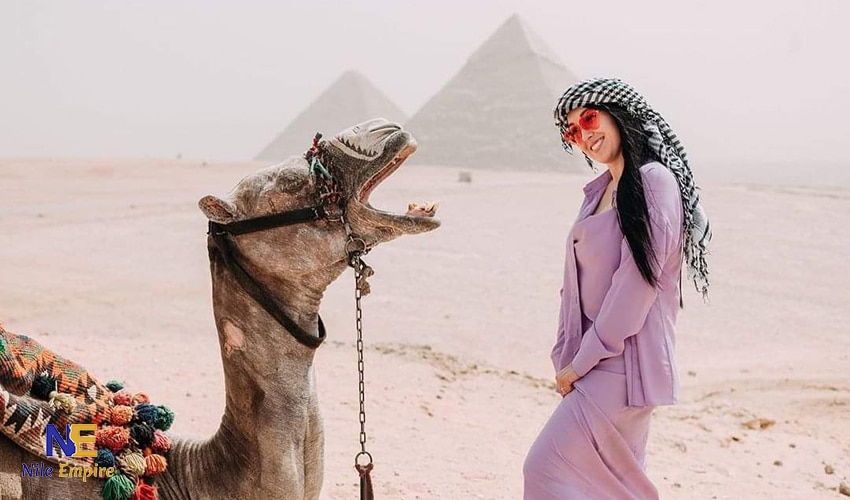
This is ground zero for aggressive selling. Because it is the most famous landmark in the country, it attracts the most determined hawkers. You will be bombarded by men offering “official” camel rides, selling headdresses, and offering to take your photo (which they will then demand payment for). Survival Tip: Never give your phone or camera to a stranger offering to take a picture of you holding the top of the pyramid. Stick to your guide.
Khan el-Khalili Bazaar (Cairo)
The labyrinthine Khan el-Khalili is a sensory overload of sights, sounds, and persistent merchants. As you walk down the narrow alleys, vendors will stand outside their shops calling out to you. The atmosphere here is less aggressive than Giza and more theatrical. Survival Tip: If you want to explore the market without the stress of constant haggling, book our Tour to El Moez Street & Khan Elkhalili Bazaar. Your guide will navigate the complex alleys, take you to fixed-price stores if you prefer, and ensure you do not get lost.
Luxor and the Valley of the Kings
As you exit the monumental tombs in the Valley of the Kings, you are forced to walk through a long, gauntlet-style market before reaching the tram that takes you back to the visitor center. The vendors here are incredibly vocal. Survival Tip: Keep your head down, keep walking, and do not stop to look at the alabaster statues until you are back with your tour group.
The Safe Havens: Nile Cruises and the Red Sea
If you are looking for a break from the hustle, there are sanctuaries. Stepping aboard one of the luxury Nile cruises provides immediate relief; there are no vendors on the boats, and you can relax in total peace. Similarly, the Red Sea resort towns like Hurghada and Sharm El-Sheikh operate in a different tourism bubble. The shops there are more relaxed, and many offer fixed prices without the need for intense haggling.
Conclusion: Do Not Let the Hustle Hide the Magic
Learning how to avoid scams in Egypt is essentially a rite of passage for any traveler visiting the Middle East. Yes, the persistence can be overwhelming, and yes, it requires a shift in your usual polite demeanor. However, it is crucial not to let these interactions sour your perception of the Egyptian people, who are overwhelmingly warm, hospitable, and genuinely thrilled to welcome you to their country.
By keeping your hands empty, mastering a firm “La Shukran,” wearing your sunglasses, and utilizing the walk-away technique, you can navigate the souks and temples with the confidence of a seasoned explorer. But remember, you do not have to do it alone.
The ultimate luxury in Egyptian travel is peace of mind. By booking your entire journey through a certified, top-tier agency, you bypass the friction of the streets entirely. Whether you are gazing at the Golden Mask of Tutankhamun or sailing the tranquil waters of Aswan, our expert Egyptologists stand as your personal shield against aggressive vendors, ensuring you experience nothing but the pure, unadulterated magic of antiquity.
Ready for a Stress-Free Egyptian Adventure?
Stop worrying about the logistics and let the experts handle the hustle. Explore our meticulously crafted Egypt travel packages today. From airport meet-and-greets to private guided tours, we guarantee a secure, luxurious, and completely hassle-free journey through the land of the Pharaohs. Contact our team to start planning your dream vacation.
Frequently Asked Questions (FAQs)
1. What is the most polite way to say no to a vendor in Egypt?
The most effective and culturally understood way to decline an offer is to say “La Shukran” (No, thank you) firmly while placing your right hand over your heart. This signifies a polite but absolute refusal. Do not apologize or say “maybe later,” as this invites further conversation.
2. Is it safe to buy souvenirs from street vendors at the Pyramids?
While it is safe from a physical standpoint, buying from street hawkers at major monuments often results in significantly overpaying for low-quality, mass-produced items (like fake papyrus made from banana leaves). It is highly recommended to wait and ask your tour guide to take you to government-approved, fixed-price shops or reputable artisans for authentic souvenirs.
3. Why are street vendors in Egypt so aggressive compared to other countries?
The aggressiveness is rooted in economics. Egypt relies heavily on tourism, and many vendors operate in highly saturated markets where competition is fierce. Their assertive sales tactics are a cultural norm for business in local bazaars, aiming to wear down the buyer’s hesitation. It is a business strategy, not a personal attack on the tourist.
4. Will having a tour guide really stop vendors from bothering me?
Yes, absolutely. Traveling with a licensed Egyptologist guide acts as a powerful deterrent. Vendors recognize professional guides and adhere to an unspoken rule of respect, generally leaving guided groups alone. If a vendor does approach, the guide will handle the dismissal swiftly in Arabic, ensuring your experience remains peaceful and uninterrupted.

