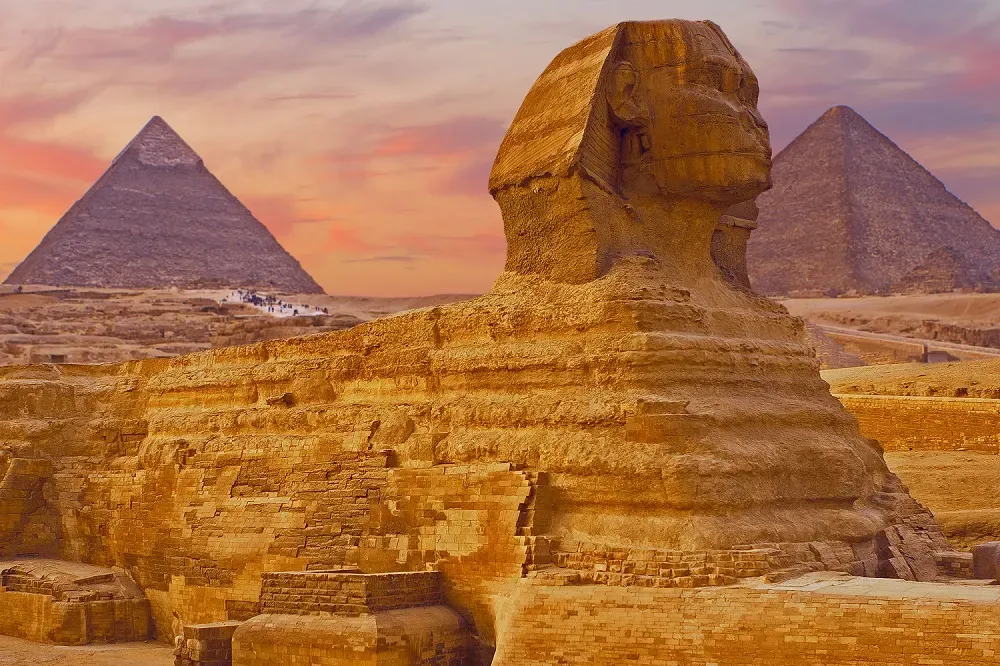
How Egyptian hieroglyphs work, with a chart of the one-consonant signs, the meaning of common symbols such as the ankh and djed, cartouches, the Rosetta Stone and where to see hieroglyphs in Egypt.
Hieroglyphs are the picture signs the ancient Egyptians carved and painted on temples, tombs, statues and coffins. They look like pictures, but most of them spell sounds. This guide explains how the script works, gives a chart of the one-consonant signs and the meaning of the symbols you will see most often, and lists the places in Egypt where you can see hieroglyphs for yourself.
What are Egyptian hieroglyphs?
The word comes from the Greek hieros and glyphos, "sacred inscriptions", a name that refers to their use on the walls of temples and tombs. Hieroglyphs are a script, not a language. The ancient Egyptian language was written in four scripts over its history: hieroglyphic, hieratic, demotic and Coptic.
Writing in Egypt appeared around 3250 BC, according to the British Museum, first to keep track of goods. Hieroglyphs were then used to write Egyptian for more than 3,000 years. The last dated hieroglyphic inscription was carved by a priest named Esmet-Akhom at the temple of Isis at Philae in AD 394.
Between about 700 and 1,000 signs were in regular use through the Old, Middle and New Kingdoms. In the Greco-Roman period the number of variant signs grew to about 10,000, as counted by some modern scholars.
How hieroglyphic writing works
Many signs depict people, animals, parts of the body, plants, buildings or tools. Others are strokes or schematic shapes. A sign can be used in three ways.
Sound signs
Most signs stand for sounds, and only for consonants. About two dozen signs stand for a single consonant, such as the mouth 𓂋 for r. Others stand for two consonants, such as the house plan 𓉐 for pr or the three fox skins 𓄟 for ms, and some stand for three, such as the ankh 𓋹 for ꜥnḫ or the heart and windpipe 𓄤 for nfr. Vowels were never written, which is why nobody knows exactly how the language sounded; modern readings such as "nefer" for nfr are conventions.
Word signs
A sign can also stand for the thing it shows. The house plan 𓉐 can simply mean "house", and the sun disc 𓇳 can mean "sun".
Determinatives
Determinatives are silent signs placed at the end of a word to show what kind of word it is. A seated man 𓀀 marks words for people, a seated woman 𓁐 marks female words and a seated god 𓀭 marks words for gods. The sun disc also works as a determinative for words about the sun, light and time. So the word for "sun" is written 𓂋𓂝𓇳: mouth (r), forearm (ꜥ) and the sun disc as determinative, read rꜥ, "ra".
Which way to read
Hieroglyphs were written in horizontal rows or vertical columns, from right to left or from left to right, with no punctuation and no spaces between words. The rule is simple: read towards the faces. If the people and animals face right, start on the right; if they face left, start on the left. Columns are read from top to bottom.
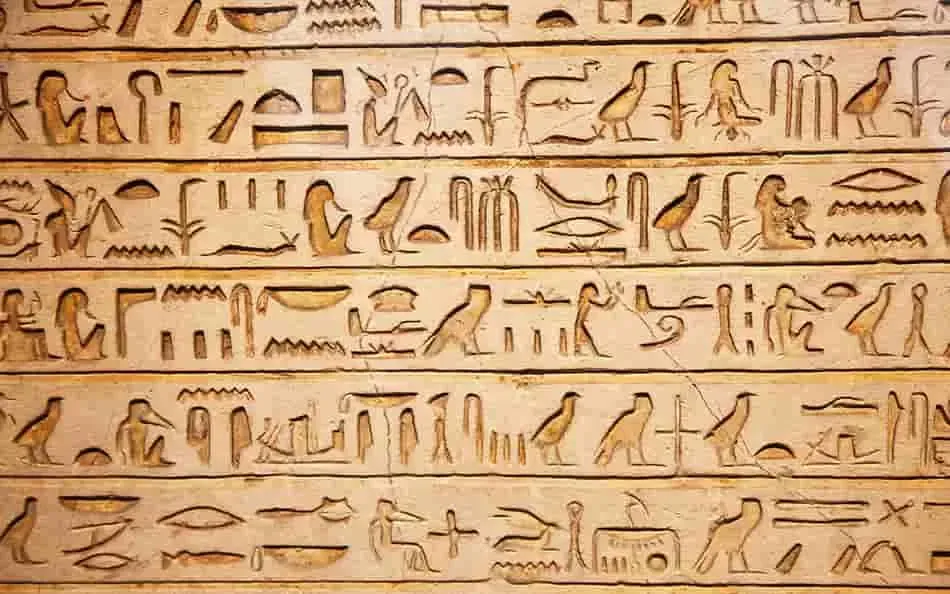
In the carving above, the birds face right, so each row is read from right to left.
Egyptian hieroglyphs chart: the one-consonant signs
This is the set of signs often called the hieroglyphic "alphabet". It is not a true alphabet: each sign stands for one consonant, no vowels are written, and the Egyptians used these signs alongside hundreds of word signs and determinatives rather than on their own. The Gardiner number is the standard catalogue number Egyptologists use for each sign. The sound column gives the conventional value; the ancient pronunciation is not known exactly.
| Sign | Gardiner no. | What it shows | Transliteration | Approximate sound |
|---|---|---|---|---|
| 𓄿 | G1 | Egyptian vulture | ꜣ | a (the conventional reading) |
| 𓇋 | M17 | Flowering reed | i | i |
| 𓇌 or 𓏭 | M17A, Z4 | Two reeds, or two strokes | y | y |
| 𓂝 | D36 | Forearm | ꜥ | a deep a made in the throat, like Arabic ع (ayn) |
| 𓅱 or 𓏲 | G43, Z7 | Quail chick, or a spiral sign | w | w |
| 𓃀 | D58 | Foot and lower leg | b | b |
| 𓊪 | Q3 | Stool of reed matting | p | p |
| 𓆑 | I9 | Horned viper | f | f |
| 𓅓 | G17 | Owl | m | m |
| 𓈖 | N35 | Ripple of water | n | n |
| 𓂋 | D21 | Mouth | r | r |
| 𓉔 | O4 | Reed shelter | h | h |
| 𓎛 | V28 | Wick of twisted flax | ḥ | a strong h, like Arabic ح |
| 𓐍 | Aa1 | Placenta (probably) | ḫ | kh, like Arabic خ |
| 𓄡 | F32 | Animal's belly with udder and tail | ẖ | a second kh sound |
| 𓊃 | O34 | Door bolt | s | s |
| 𓋴 | S29 | Folded cloth | s | s |
| 𓈙 | N37 | Pool | š | sh |
| 𓈎 | N29 | Sandy hill slope | q | q |
| 𓎡 | V31 | Basket with handle | k | k |
| 𓎼 | W11 | Ring stand for jars | g | g (hard, as in go) |
| 𓏏 | X1 | Loaf of bread | t | t |
| 𓍿 | V13 | Tethering rope | ṯ | tj or ch |
| 𓂧 | D46 | Hand | d | d |
| 𓆓 | I10 | Cobra | ḏ | dj |
Two different signs, the door bolt and the folded cloth, both spell s. Because the script had no vowel signs, charts that give a hieroglyph for every letter of the English alphabet are modern aids for writing names, not an ancient system.
Common Egyptian hieroglyphs and their meanings
These are the signs and symbols visitors ask about most. Several also appear on amulets and jewellery, where they work as good wishes: the ankh, djed and was together mean "life, stability and dominion", a common group of wishes in Egyptian inscriptions.
| Sign | Gardiner no. | What it shows | Reading | Meaning |
|---|---|---|---|---|
| 𓋹 | S34 | Sandal strap (the ankh) | ꜥnḫ (ankh) | Life |
| 𓊽 | R11 | Column of tied stalks (the djed pillar) | ḏd (djed) | Stability |
| 𓌀 | S40 | Sceptre topped by the head of the Seth animal (the was sceptre) | wꜣs (was) | Dominion, power |
| 𓂀 | D10 | Eye with the markings of a falcon's head (the wedjat eye) | wḏꜣt (wedjat) | The healed eye of Horus; a protective amulet |
| 𓆣 | L1 | Scarab (dung beetle) | ḫpr (kheper) | To come into being, to become |
| 𓄤 | F35 | Heart and windpipe | nfr (nefer) | Good, beautiful |
| 𓊹 | R8 | Cloth wound on a pole | nṯr (netjer) | God |
| 𓍶 | V9 | Round cartouche (the shen ring) | šnꞽ (sheni) | To surround or encircle |
| 𓍷 | V10 | Oval cartouche | rn (ren) | Name |
| 𓇳 | N5 | Sun disc | rꜥ (ra) | Sun; the sun god Ra |
| 𓉐 | O1 | Plan of a house | pr (per) | House |
| 𓅃 | G5 | Falcon | ḥr | Horus |
| 𓏞 | Y3 | Scribe's kit: palette, ink pouch and reed pen | sš | Scribe, writing |
Cartouches and royal names
A cartouche is the oval ring, with a short bar at one end, that encloses a king's name. The two main royal names, the throne name and the birth name, were normally written inside cartouches, so a cartouche is the quickest way to spot a royal name on a wall. As a hieroglyph, the oval cartouche can mean simply "name", and its round form, the shen ring, means "to encircle".
One royal title to look for beside cartouches is "son of Ra", written with a duck 𓅭, read sꜣ ("son"), and the sun disc 𓇳. Inside the cartouche, the name is spelled with ordinary sound signs. Ramesses, for example, is written with the sun disc (ra), the three fox skins (ms) and two door bolts 𓊃𓊃 (s, s).
Hieroglyphic, hieratic, demotic and Coptic
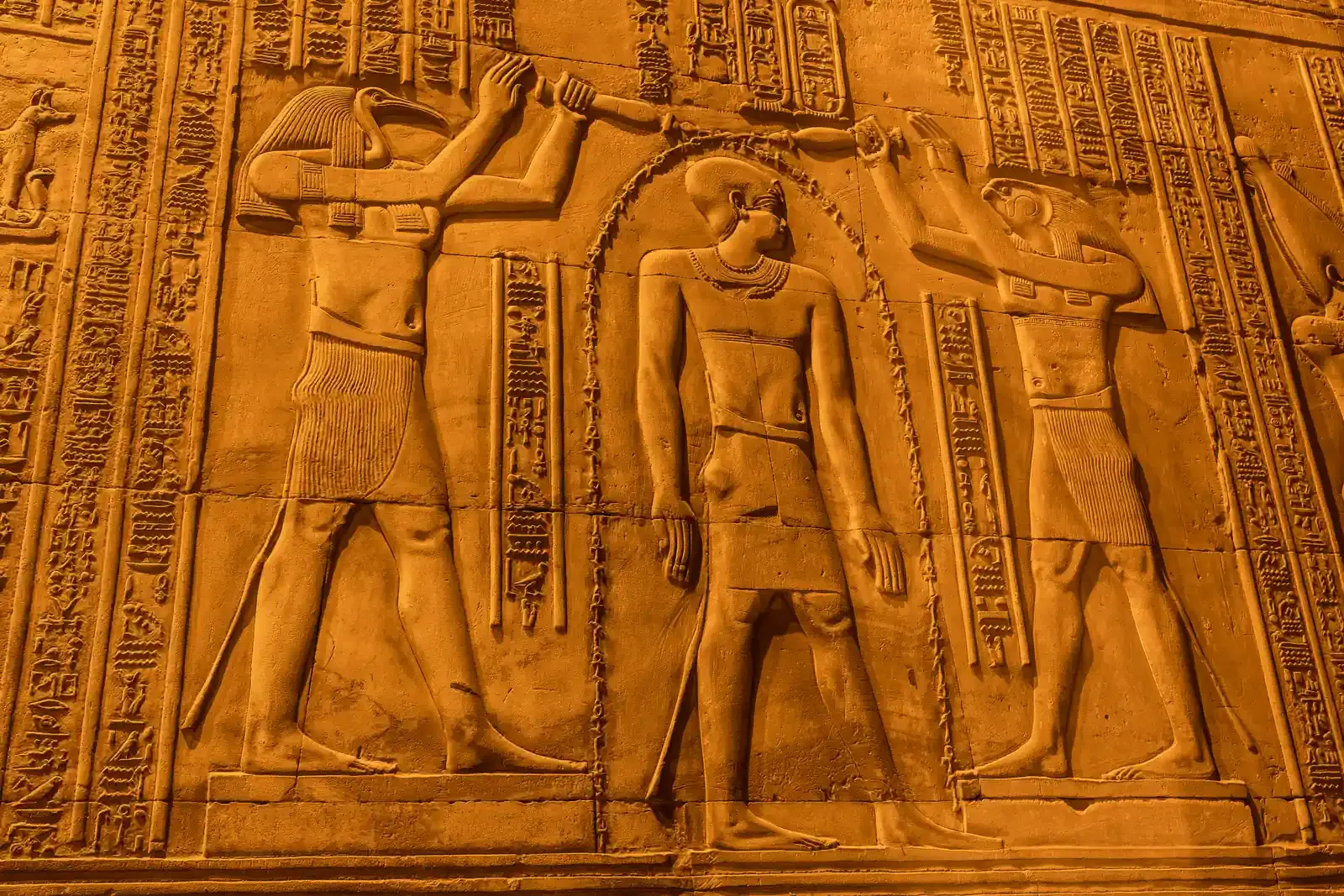
- Hieroglyphic: the formal picture script, carved or painted on monuments and objects of every kind. It could be written in either direction.
- Hieratic: a faster, less pictorial script written with a brush or reed pen and ink, mostly on papyrus and ostraca (flakes of pottery and stone), and mostly from right to left. The name means "priestly", because in Greek and Roman times priests were its main users.
- Demotic: a still more cursive script that developed from hieratic and was used for everyday documents and literature. The name means "popular".
- Coptic: Egyptian written in the Greek alphabet plus a few extra letters taken from demotic, in place by about AD 100. It is the first Egyptian script to write vowels, and Coptic lives on as the liturgical language of Egypt's Coptic Church.
How hieroglyphs were deciphered
As ancient temples closed and writing practices changed, the knowledge needed to read hieroglyphs was lost. The key to recovering it was the Rosetta Stone, found in July 1799 when French soldiers were rebuilding an old fort at Rashid (Rosetta). It carries a decree drawn up by a council of priests at Memphis on 27 March 196 BC, in the reign of Ptolemy V, repeated in hieroglyphic, demotic and Greek. The stone passed to Britain in 1801 and is now in the British Museum in London.
See the Rosetta Stone in the British Museum collection.
Because the Greek could be read, scholars had a parallel text. The English scholar Thomas Young showed that demotic used both sound signs and idea signs, and correctly identified several sound signs in the names Ptolemy and Berenice. The French scholar Jean-François Champollion compared the cartouches of Ptolemy and Cleopatra, used his knowledge of Coptic, and then showed that sound spelling was used for Egyptian names too, reading the name Ramesses. On 14 September 1822 he announced to his brother that he had cracked the code; the letter he then wrote to the scholar Bon-Joseph Dacier is considered the moment of decipherment.
Where to see hieroglyphs in Egypt
- Saqqara: the Pyramid of Unas holds the first known Pyramid Texts, spells carved on the walls of the burial chamber to help the king in the afterlife. Access to individual pyramids changes, so check before you go. Saqqara is on our Saqqara, Memphis and Dahshur tour.
- Karnak: reliefs cover the walls of the temple of Amun, and the Great Hypostyle Hall, a forest of 134 columns, was decorated under Seti I and Ramesses II.
- Luxor Temple: look for the Divine Birth scenes in the inner rooms and the Opet Festival scenes along the Great Colonnade, completed under Tutankhamun and Horemheb. Karnak and Luxor Temple are both on our Luxor East Bank tour.
- Valley of the Kings: the royal tombs are decorated with funerary texts; the tomb of Seti I, the first in the valley to be decorated throughout, carries the Litany of Re, the Amduat and the Book of Gates. See our guides to the Valley of the Kings and the tomb of Seti I.
- Abydos: in the temple of Seti I, the Abydos King List names 76 kings in two rows of cartouches.
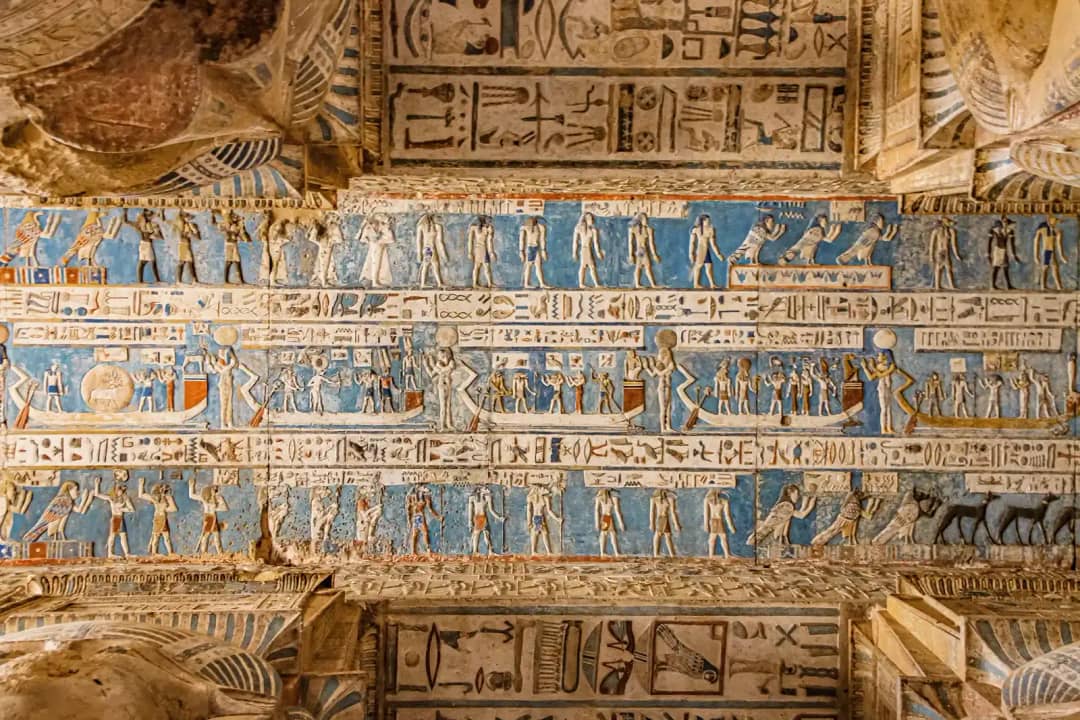
- Dendera: the Ptolemaic temple of Hathor is known for the astronomical carvings on its ceiling. Abydos and Dendera are combined on our Dendera and Abydos tour.
- Edfu: the temple of Horus, built between 237 and 57 BC, is one of the most complete Egyptian temples; its pylons show Ptolemy XII defeating his enemies.
- Kom Ombo: the double temple of Sobek and Horus the Elder has carved calendars of festivals and a Roman scene believed to show surgical instruments. Edfu and Kom Ombo are both on our Kom Ombo and Edfu tour.
- Philae: the temple of Isis, relocated to Agilkia between 1972 and 1979, holds the last dated hieroglyphic inscription (AD 394), on the Gateway of Hadrian. See it on our Philae Temple and High Dam tour.
- Grand Egyptian Museum: the colossal statue of Ramesses II in the entrance and more than 5,000 objects from Tutankhamun's treasures are on show; try spotting cartouches among them. Our Tutankhamun guide covers the galleries.
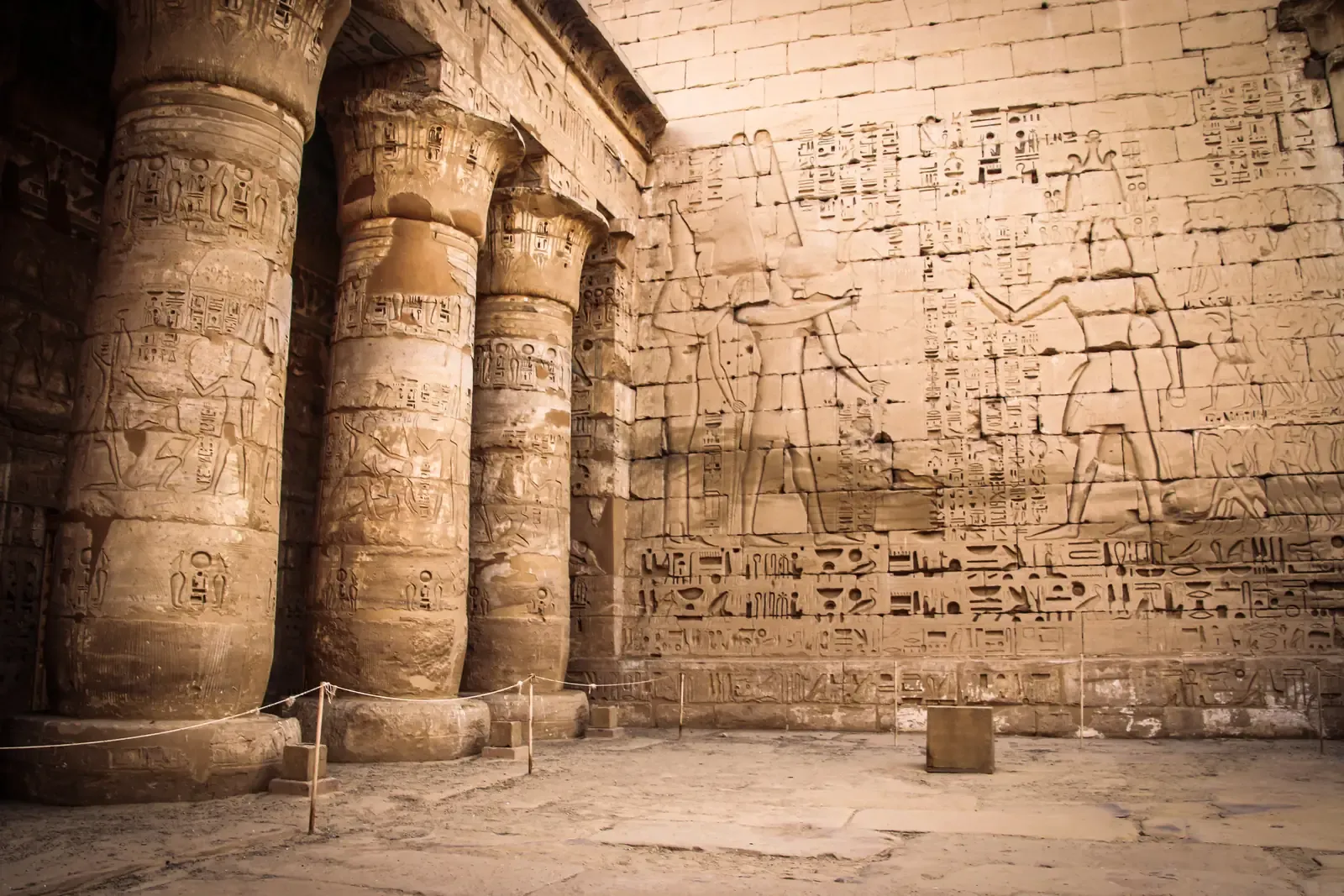
Knowing a dozen signs changes how a temple wall looks: names in cartouches, the ankh in a god's hand, the sun disc above a king. If you would like someone to read the walls with you, our private tours are led by certified Egyptologist guides; the Luxor day tours cover Karnak, Luxor Temple and the Valley of the Kings.
Frequently Asked Questions
Is there a hieroglyphic alphabet?
Not a true one. About two dozen hieroglyphs each stand for a single consonant, and they are often shown as an alphabet chart, but the Egyptians never wrote vowels and always mixed these signs with two and three consonant signs, word signs and determinatives.
Which way do you read hieroglyphs?
Towards the faces. Hieroglyphs can run left to right or right to left, in rows or in columns. If the people and animals face right, start reading on the right; if they face left, start on the left. Columns are read from top to bottom.
Can a guide help me read hieroglyphs on my trip?
Yes. Our private tours are led by certified Egyptologist guides, who can point out royal names in cartouches and common signs such as the ankh, djed and was on temple and tomb walls. Learning the one-consonant signs in this guide before you travel makes it easier to follow.