How Egypt's pyramids developed from Djoser's Step Pyramid to Giza, the original and present heights of the Giza pyramids, what is inside Khufu's pyramid and who built them.
The pyramids of Giza are the best-known monuments of ancient Egypt, but they were the result of several generations of experiment that began with Djoser's Step Pyramid at Saqqara. This guide follows that story, gives the original and present heights of the three Giza pyramids, looks inside Khufu's pyramid, and separates what the evidence shows about the builders from what is still hypothesis.
What were the pyramids for?
Each Giza pyramid was the tomb at the heart of a king's funerary complex. According to the Ministry of Tourism and Antiquities, each complex also had smaller queens' pyramids, tombs for nobles and family members, boat burials, and two temples linked by a causeway, where priests kept up the dead king's cult with offerings.
What the evidence shows about the burials themselves is more limited:
- No royal body has been found. None of the three Giza pyramids has yielded a king's mummy or treasure. All three were plundered in ancient and medieval times, which Britannica says likely affected the kings' bodies too.
- Khufu's sarcophagus is still in place. The King's Chamber holds the broken stone sarcophagus that the Ministry identifies as the one in which Khufu was laid to rest.
- Menkaure's burial was restored centuries later. A wooden coffin inscribed with Menkaure's name was found in his pyramid and has been in the British Museum since 1838. The museum dates it to the 26th Dynasty and states that it was not part of the original burial but was made for a later restoration of it.
The missing mummies therefore do not show that the kings were never buried in their pyramids. Ancient plundering is a likely reason so little was left. What survives is consistent with their use as royal tombs, although no royal body has been recovered.
How the pyramid shape developed
Djoser's Step Pyramid at Saqqara
Before the pyramids, kings and the elite were buried under mastabas, rectangular structures built over an underground tomb. Djoser's Step Pyramid at Saqqara, built early in the 3rd Dynasty (Djoser reigned c. 2667 to 2648 BC), is made of six stacked mastabas, which creates its stepped profile. Its architect, Imhotep, may have been responsible for this innovation. The Ministry describes it as the first pyramid the ancient Egyptians built and the oldest known ancient Egyptian stone structure.
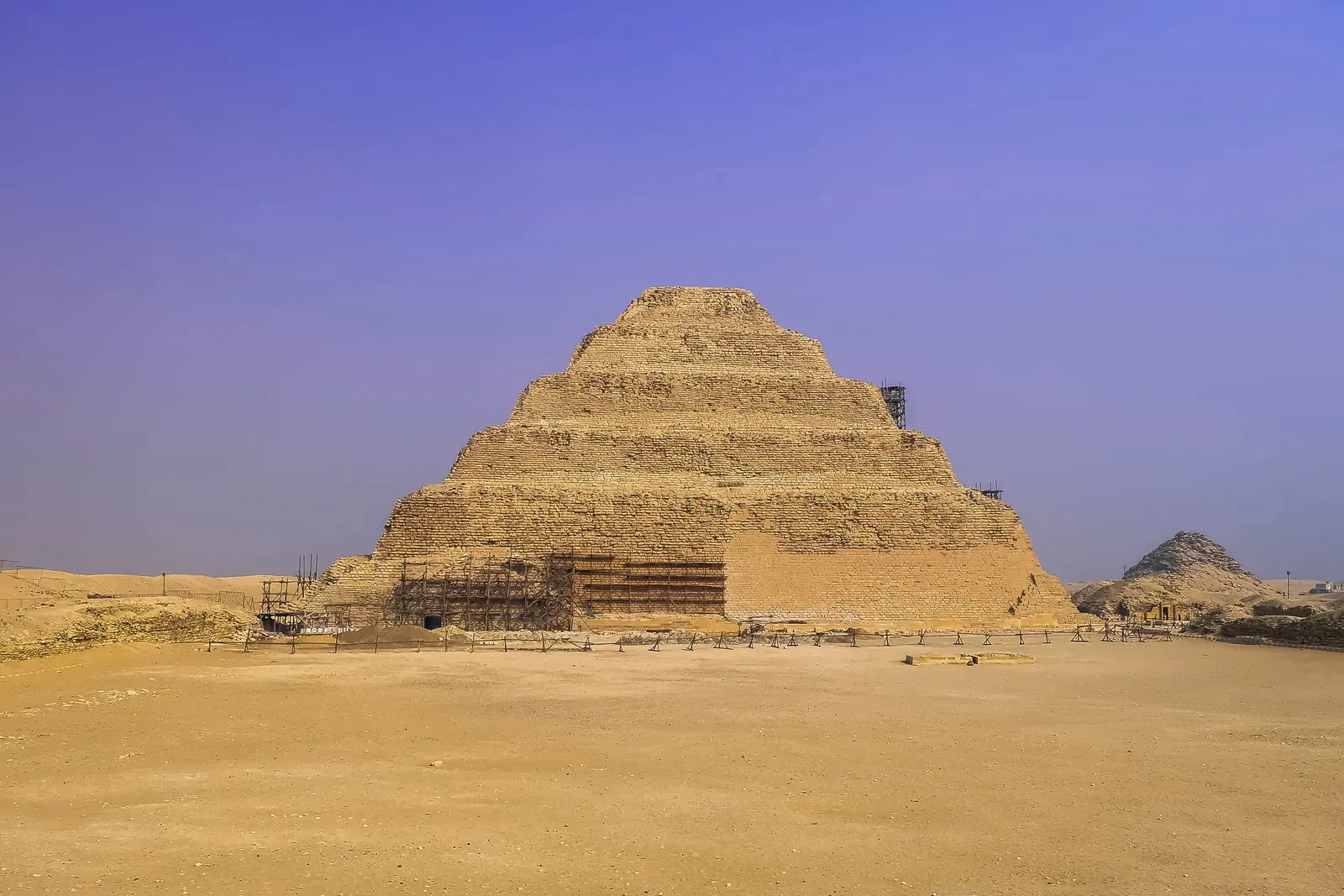
Djoser's Step Pyramid at Saqqara, the first pyramid built in Egypt.
Meidum: from steps to smooth sides
Sneferu (c. 2613 to 2589 BC), the first king of the 4th Dynasty and Khufu's father, began his pyramid at Meidum as a step pyramid of seven steps, then enlarged it to eight. After building his two pyramids at Dahshur, he had it transformed into a true pyramid with smooth sides, between 92 and 95 metres high. Today it looks like a three-stepped tower rising from a mound of debris. Meidum is also where corbelled stone ceilings first appear, the technique later used in the Grand Gallery of Khufu's pyramid.
Dahshur: the Bent Pyramid and the Red Pyramid
At Dahshur, Sneferu built a pyramid with smooth sides from the start. The Bent Pyramid was begun with its faces rising at an angle of about 55 degrees, but partway up the builders reduced the angle to about 43 degrees, because the weight of the blocks was making the structure unstable. That change of slope gives the pyramid its name.
About one kilometre to the north, Sneferu then built the Red Pyramid, a complete smooth-sided pyramid. Its name comes from the reddish colour of its stone; it was once cased in white limestone from Tura, south of modern Cairo. The Ministry lists it as the third-largest Egyptian pyramid, after those of Khufu and Khafre. Our Saqqara, Memphis and Dahshur day tour follows this sequence on the ground.
Giza
Khufu (c. 2589 to 2566 BC) chose the Giza plateau for the largest pyramid of all, and his son Khafre and Menkaure, probably his grandson, built the second and third pyramids beside it. Giza is part of the UNESCO World Heritage Site "Memphis and its Necropolis: the Pyramid Fields from Giza to Dahshur", which UNESCO says contains more than thirty-eight pyramids, including those of Abusir, Saqqara and Dahshur. For the wider history, see our facts about ancient Egyptian history.
The Giza pyramids in figures
All three pyramids have lost their capstones and most of their smooth outer casing, so each is lower today than when it was finished. Published figures differ by a metre or two, so the heights below are rounded.
| Pyramid | King and reign | Original height | Height today | Outer casing |
|---|---|---|---|---|
| Great Pyramid | Khufu, c. 2589 to 2566 BC | about 146.5 m | about 137 to 139 m | Fine white Tura limestone, now almost entirely gone |
| Second pyramid | Khafre, c. 2558 to 2532 BC | about 143.5 m | about 136 m | Tura limestone; a cap of casing survives near the top |
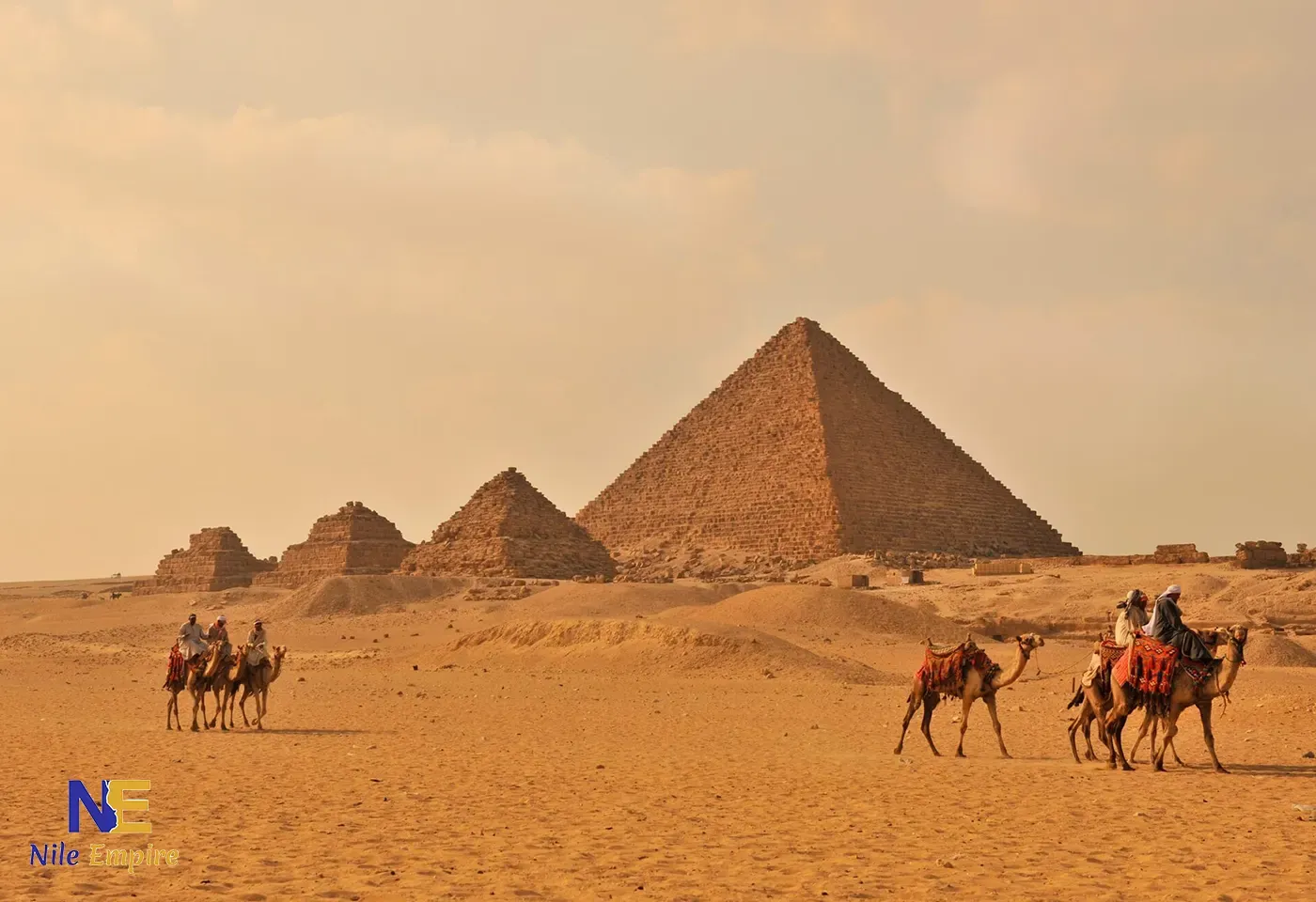
| Third pyramid | Menkaure, c. 2532 to 2503 BC | about 65 m | about 62 m | Aswan granite on the lowest quarter, much of it never smoothed; limestone above |
- Why Khafre's pyramid can look taller. It stands on slightly higher ground, so it appears as tall as his father's.
- Size of the Great Pyramid. Its base measures about 230 m on each side, and it is built of roughly 2.3 million stone blocks weighing about 5.75 million tons in total.
- A record that lasted millennia. The Ministry says it was the tallest structure in the world for 3,800 years, and it is the last surviving of the Seven Wonders of the Ancient World.
- Precise alignment. Its sides face north, south, east and west with an accuracy of better than one-fifteenth of a degree, a figure quoted by the engineer Glen Dash.
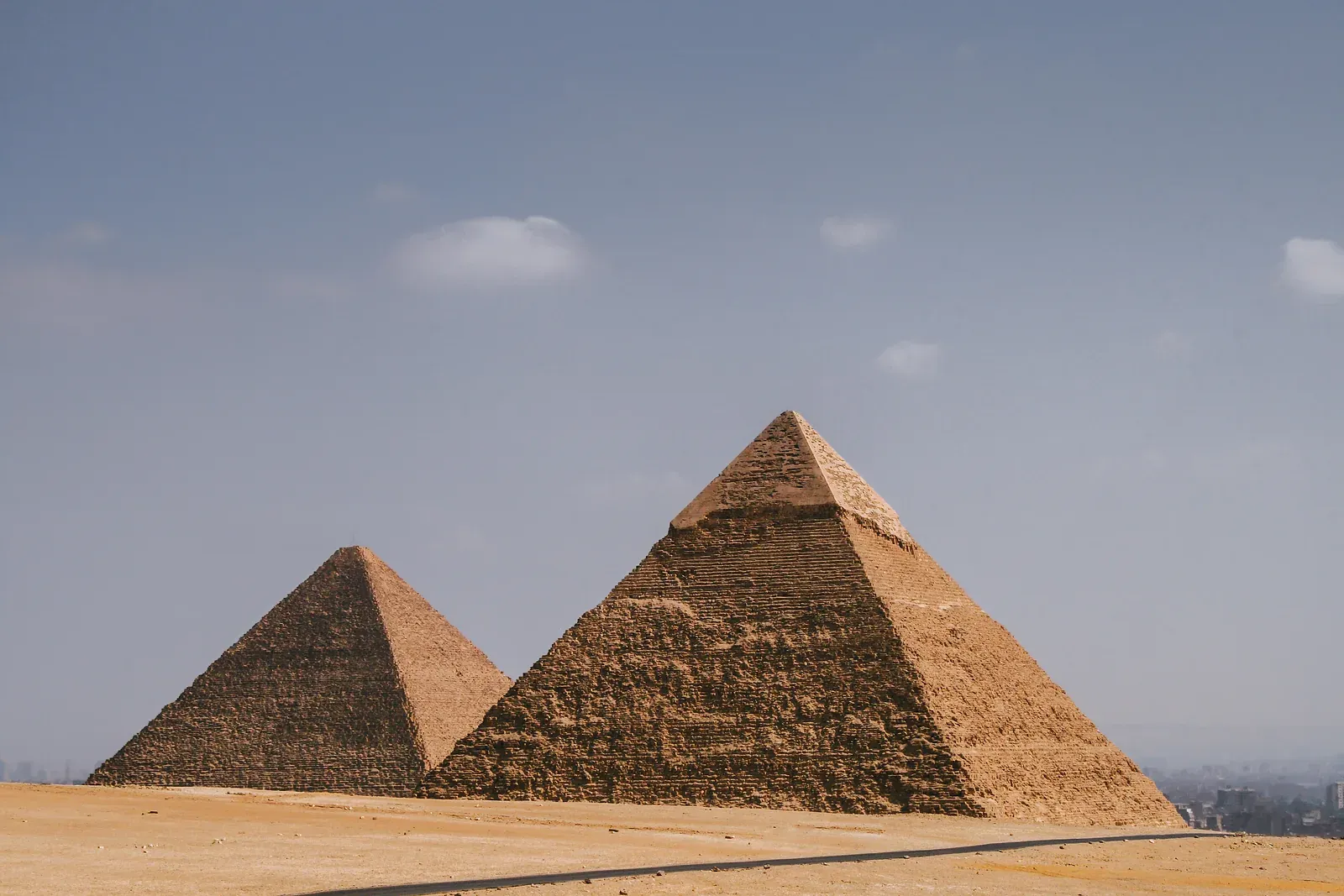
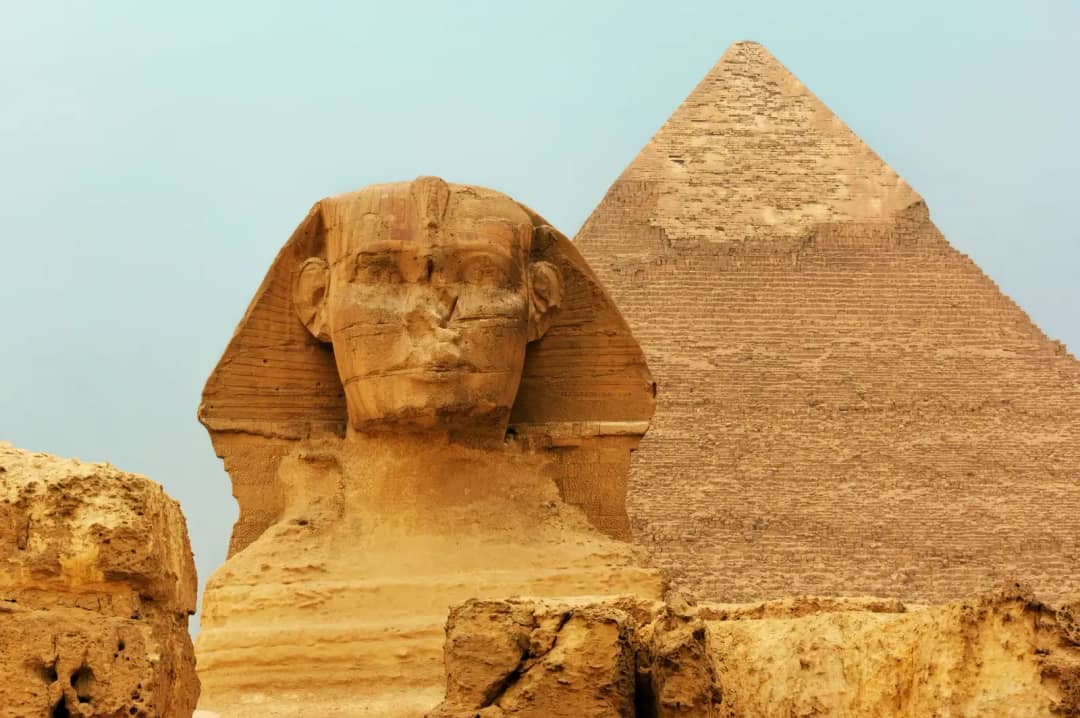
The Pyramid of Khafre (right), recognisable by the casing stones that still cover its upper part, with a second Giza pyramid behind it.
Inside Khufu's pyramid
Khufu's pyramid has three chambers: one cut into the bedrock beneath it and two built high up in the masonry. Khafre's and Menkaure's pyramids, by contrast, have passages at their base that lead to burial chambers under the pyramid.
- The entrance. The original entrance is on the north face, about 18 m above the ground. Visitors today use a lower passage dug in the Middle Ages and attributed to the caliph al-Ma'mun.
- The lower chambers. A descending corridor ends in an unfinished chamber cut into the bedrock. An ascending passage leads to the room known as the Queen's Chamber and to the Grand Gallery, a corbelled passage about 46 m long.
- The King's Chamber. The burial chamber is lined and roofed with granite and still holds the broken sarcophagus. Above it are five compartments separated by granite slabs, most likely built to divert the weight of the masonry away from the chamber's ceiling.
- Builders' graffiti. In the 1830s, graffiti left by the workers were found that identify the pyramid as Khufu's. Otherwise the Giza pyramids have no inscriptions or decoration inside; that practice began centuries later.
If you are deciding whether to buy the separate ticket to go inside, our guide Inside the Great Pyramid of Giza: is it worth it? describes the climb and what you will see.
Who built the pyramids, and how?
What the evidence shows
- A town for the builders. Since 1988, Ancient Egypt Research Associates (AERA) have excavated a settlement 400 m south of the Sphinx, known as Heit el-Ghurab. It covered more than 7 hectares and served as the base for building the pyramid complexes of Menkaure, Khafre and probably Khufu. It had workshops, bakeries, warehouses, houses and large galleries that may have been the workers' barracks.
- A well-fed workforce. Large quantities of fish, bird, cattle, sheep, goat and pig bones were found in the town, a sign, the Ministry says, that the state kept the workers healthy.
- A cemetery with signs of medical care. In the cemetery west of the town, many skeletons show hard physical labour and broken bones, but most fractures had healed correctly, which indicates good medical care.
- Merer's logbook. Papyri found at Wadi al-Jarf, on Egypt's Red Sea coast, date to the end of Khufu's reign and are the oldest inscribed papyri ever found in Egypt. They include the logbook of Merer, leader of a working party, recording how his team brought limestone blocks by boat from the Tura quarries to Giza.
- Sledges. A wall painting in the tomb of Djehutihotep shows a large statue pulled on a sledge while a man wets the sand in front of it. University of Amsterdam experiments found that correctly dampened sand halves the pulling force.
Taken together, the finds show an organised workforce supplied with food and medical care. They challenge the slave-gang image in popular films, but do not establish every worker's legal status.
What is still hypothesis
- How the blocks were raised. The Ministry says it is still not entirely certain how the Great Pyramid was built. Britannica describes the most plausible theory as a sloping, encircling embankment of brick, earth and sand, raised as the pyramid grew, with blocks hauled up on sledges, rollers and levers. It remains a theory, not an observed fact.
- How many people worked on it. The Greek historian Herodotus gave a figure of 100,000 men. Archaeologists have since suggested that as few as 20,000 workers, with support staff such as bakers, physicians and priests, could have been enough. Both are estimates.
- How long it took. The Ministry estimates 10 to 20 years for the Great Pyramid.
- How the alignment was set out. Glen Dash has shown that tracking the sun's shadow on the autumn equinox produces a line matching the pyramids' orientation, but he acknowledges that the Egyptians left few clues about their method.
Recent discoveries inside the Great Pyramid
The ScanPyramids team images the pyramid with muons, particles produced by cosmic rays, to detect hidden spaces without drilling.
- The Big Void (2017). In November 2017 the journal Nature published the discovery of a large void above the Grand Gallery, at least 30 m long, with a cross-section similar to the Gallery's. It was the first major inner structure found in the pyramid since the 19th century, and its purpose is unknown.
- The North Face Corridor (2023). In March 2023 Nature Communications published measurements of a corridor-shaped space about 9 m long and about 2 m by 2 m in section, behind the chevron-shaped blocks on the north face.
Outside the pyramid, two dismantled ships were found in pits on its south side. The Ministry says they are believed to have carried the royal mummy and burial equipment to the tomb. The first boat was moved to the Grand Egyptian Museum in August 2021, and the museum has a dedicated Khufu's Boats Museum; our Grand Egyptian Museum guide helps you plan that visit.
The Great Sphinx
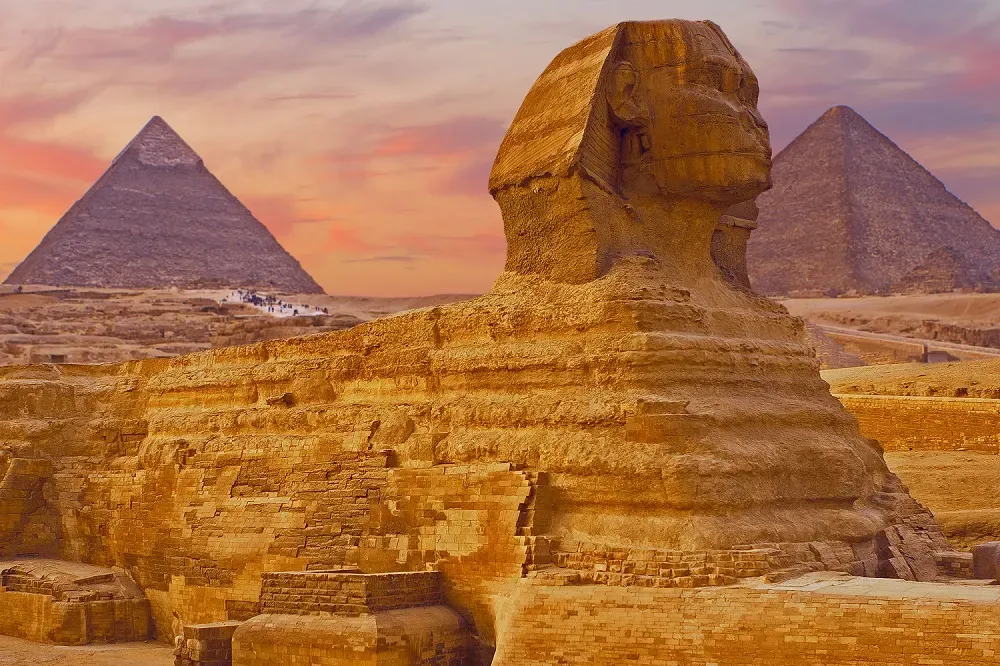
The Great Sphinx was carved directly from the bedrock beside Khafre's valley temple, with the body of a lion and the head of a king. It is about 73 m long and 20 m high. The Ministry dates it to Khafre's reign: archaeological analysis showed that his valley temple was finished before work on the Sphinx began, and its face closely resembles his statues. In the 18th Dynasty it was worshipped as Horemakhet, "Horus in the Horizon", and Thutmose IV set up the Dream Stela between its paws.
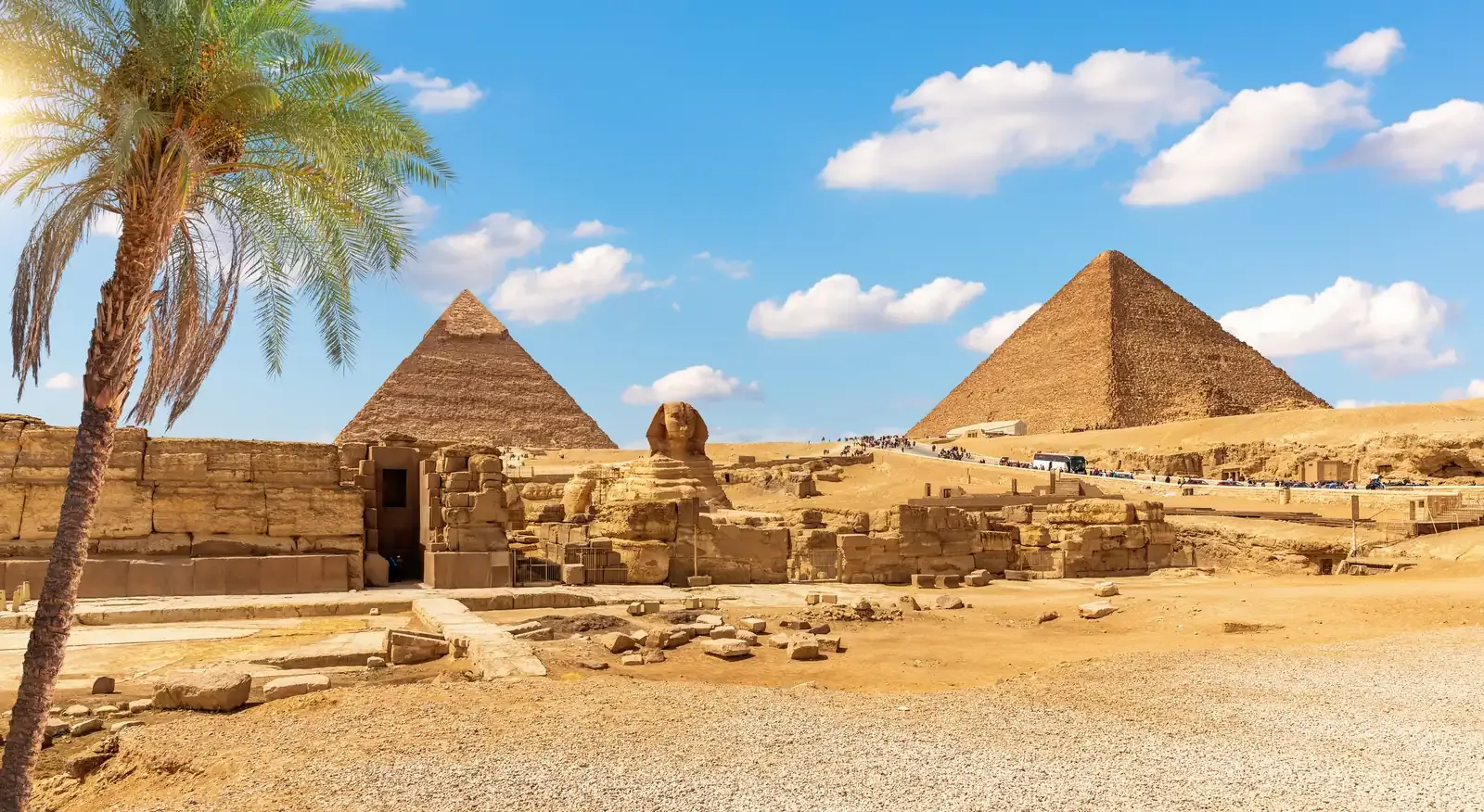
The Great Sphinx, with the Pyramid of Khafre (left, with casing near its top) and the Great Pyramid of Khufu (right).
Visiting the pyramids today
The pyramids stand on the Giza plateau, on the west bank of the Nile at the edge of Cairo. The general site ticket does not cover the interiors of the Great Pyramid and the pyramids of Khafre and Menkaure, the Tomb of Meresankh III or the Workers' Cemetery, which have their own tickets. Tickets are sold on the Ministry's official website, egymonuments.com, at card machines and at ticket offices on the plateau. Current prices are in our Egypt attractions entrance fees guide, and our guide to tourist scams at the pyramids explains what to watch for on the plateau.
To see the story from Saqqara to Giza with an expert, our private Giza Pyramids, Saqqara and Memphis day tour visits both the Step Pyramid and the Giza plateau with a certified Egyptologist guide.
Frequently Asked Questions
Was a mummy ever found in the Great Pyramid?
No. No king's body has been found in any of the three Giza pyramids. They were plundered in ancient and medieval times, which probably also affected the royal bodies. Khufu's broken stone sarcophagus is still in the King's Chamber, so the absence of a mummy does not show that he was never buried there.
How long did it take to build the Great Pyramid?
The Ministry of Tourism and Antiquities estimates 10 to 20 years. The Greek historian Herodotus gave 20 years. No one knows the exact figure.
Which is the oldest pyramid in Egypt?
Djoser's Step Pyramid at Saqqara, built early in the 3rd Dynasty during Djoser's reign (c. 2667 to 2648 BC). It is the first pyramid the Egyptians built and the oldest known ancient Egyptian stone structure.
Were the pyramids built by slaves?
The evidence points to an organised Egyptian workforce. Excavations at Giza found the builders' town, with bakeries, workshops and large amounts of animal bones from their food, and a cemetery where many skeletons show broken bones that had healed well, a sign of medical care.
What has been discovered inside the Great Pyramid recently?
Muon imaging by the ScanPyramids team revealed a void at least 30 m long above the Grand Gallery (published in 2017) and a corridor about 9 m long behind the chevron blocks on the north face (published in 2023). The purpose of the large void is unknown.
Can you buy tickets for the pyramids online?
Yes. The Ministry sells tickets on its official website, egymonuments.com, as well as at self-service card machines and ticket offices on the plateau. Entry to the interiors of the three main pyramids needs a separate ticket from the general site ticket.